
1 Carat Diamond Price · South Africa · Landed Rand Price
1 carat diamond price in South Africa
See this size at true scale on your screen →
For 1 carat diamonds in South Africa, our 19 October 2026 sample had a median of R60 800 at H colour. The middle half of sampled prices was R56 300–R66 200. This compares 0.95–1.09 ct stones at VS1–VS2 clarity, with an Excellent cut filter and no fluorescence. VAT and delivery for the loose stone are included; a setting is additional. Confirm the current price for your chosen diamond.
See current 1 carat diamond prices Get a firm 1-carat quote → Email Darren directly →
Use the guide to compare colour and clarity choices, then inspect the actual diamond and its report. When these prices were captured on 19 October 2026, our search drew on 33 590 natural 1 carat diamonds for sale between 0.95 and 1.09 carats. Prodiam stones are cut in-house or sourced through the certified trade. Ask for a written quote for the diamond and any setting you want.
What a 1 carat diamond costs in South Africa
In our 19 October 2026 sourced-price sample, a 1 carat diamond at D colour had a guide price of R88 100 and a J around R42 900. The broader selection at H colour or better, VS2 or better and an Excellent cut filter had a guide price of R77 600. Figures include VAT and delivery for the loose diamond; a ring or other setting is additional.
The same spec varies enormously, and you should expect that. At E colour, the middle 80% of the sampled prices ran from R71 700 to R112 700. These are percentile boundaries, not the cheapest and most expensive available stones. A guide helps set a budget; the individual diamond needs its own quote.
What separates them is the part a grading report summarises rather than settles: how well the stone is actually cut and how much light it returns, where the inclusions sit and whether the eye can find them, how strongly it fluoresces, how the outline is proportioned, and how keenly that particular stone happens to be priced against the international trade benchmark on the day. Weight and colour are two inputs out of a dozen.
1 carat diamond price by colour
A fair colour comparison has to hold everything else still, so this is VS1 to VS2 clarity, an Excellent cut filter and no fluorescence. The weight band is 0.95–1.09 ct. Typical is the median of the captured sample: half the sampled prices are lower, half are higher. A limited sample is labelled separately. Moving from D to J changes the typical price by about R45 200.
| Colour | Typical | Middle half falls between | At capture | |
|---|---|---|---|---|
| D | R88 100 | R77 100 to R101 800 | 774 | Check this spec → |
| E | R83 900 | R72 400 to R101 100 | 955 | Check this spec → |
| F | R77 000 | R68 400 to R87 300 | 1 099 | Check this spec → |
| G | R71 700 | R64 300 to R79 400 | 1 526 | Check this spec → |
| H | R60 800 | R56 300 to R66 200 | 1 794 | Check this spec → |
| I | R49 600 | R49 200 to R53 800 | 1 509 | Check this spec → |
| J | R42 900 | R42 500 to R45 600 | 975 | Check this spec → |
1 carat diamond price by clarity
Held at H colour within 0.95–1.09 ct. Cut and fluorescence can still vary in this selection. Ask to see the individual stone: an SI1 grade alone does not establish whether inclusions are visible.
| Clarity | Typical | Middle half falls between | At capture | |
|---|---|---|---|---|
| VVS1 | R69 700 | R69 000 to R72 400 | 822 | Check this spec → |
| VVS2 | R65 700 | R65 000 to R67 300 | 969 | Check this spec → |
| VS1 | R61 100 | R60 300 to R66 500 | 1 331 | Check this spec → |
| VS2 | R56 300 | R55 700 to R63 200 | 1 346 | Check this spec → |
| SI1 | R47 800 | R47 100 to R52 300 | 1 064 | Check this spec → |
Dated price guidance from sourced listings. These figures were captured on 19 October 2026. They describe sampled prices, not stock held in Bedfordview or a guarantee that a particular stone remains available.
Use the typical price and middle-half range together when setting a budget. Where too few prices were returned, the table labels a limited sample and omits the range. Confirm the current price and availability before deciding.
No two of these diamonds are the same
A table like this describes a market, not a stone. Treat every figure as the shape of what is available at that spec, not a price list and not a promise. A grading report identifies the stone and its grades; the price appears in your written quote for the diamond you choose.
We benchmark every stone against the trade list before we put it in front of anyone, and we would rather lose a sale than sell you one we would not buy ourselves. Come and talk to us and we will often do better than the table, because a real stone is priced on its own merits.
Price sample captured 19 October 2026. Typical is a sample median; the middle-half band is the sampled 25th to 75th percentile. Limited samples use the lower-priced listings returned and should not be read as a market median. Guide figures are rounded up to the next R100.
Ask us about a 1 carat diamondCheck current 1 carat diamonds →
-
Natural diamonds only
We sell natural diamonds and diamond-set jewellery. Ask us about the grading report and available origin documentation for your chosen stone. Why we don’t sell lab-grown →
-
Independent grading reports
The grading laboratory is shown per stone. Review its report and the individual diamond before choosing; sourced examples can include GIA, EGL and IGI.
-
Insured delivery, SA & worldwide
Overnight across South Africa via Brink’s, G4S or our nominated jewellery courier. Insured worldwide dispatch via Ferrari Group and FedEx Custom Critical.
-
14-day in-person exchange
In-person sales at the viewing room come with a 14-day exchange courtesy on stock pieces. Distance-sale CPA cooling-off applies.
How to compare 1 carat diamond prices
The dated prices above describe a specified sample of natural diamonds. A 1 carat weight alone does not determine a quote. Compare shape, cut, colour, clarity, laboratory, fluorescence and measurements, then the full VAT-inclusive price of the actual stones.
Compare 0.90 or 0.95 carats before choosing the full 1
Popular weight thresholds can carry a price premium. A stone just below the weight you searched for may offer a useful alternative, but there is no fixed saving or promise that two weights will look identical. Compare their millimetre dimensions and appearance alongside their prices.
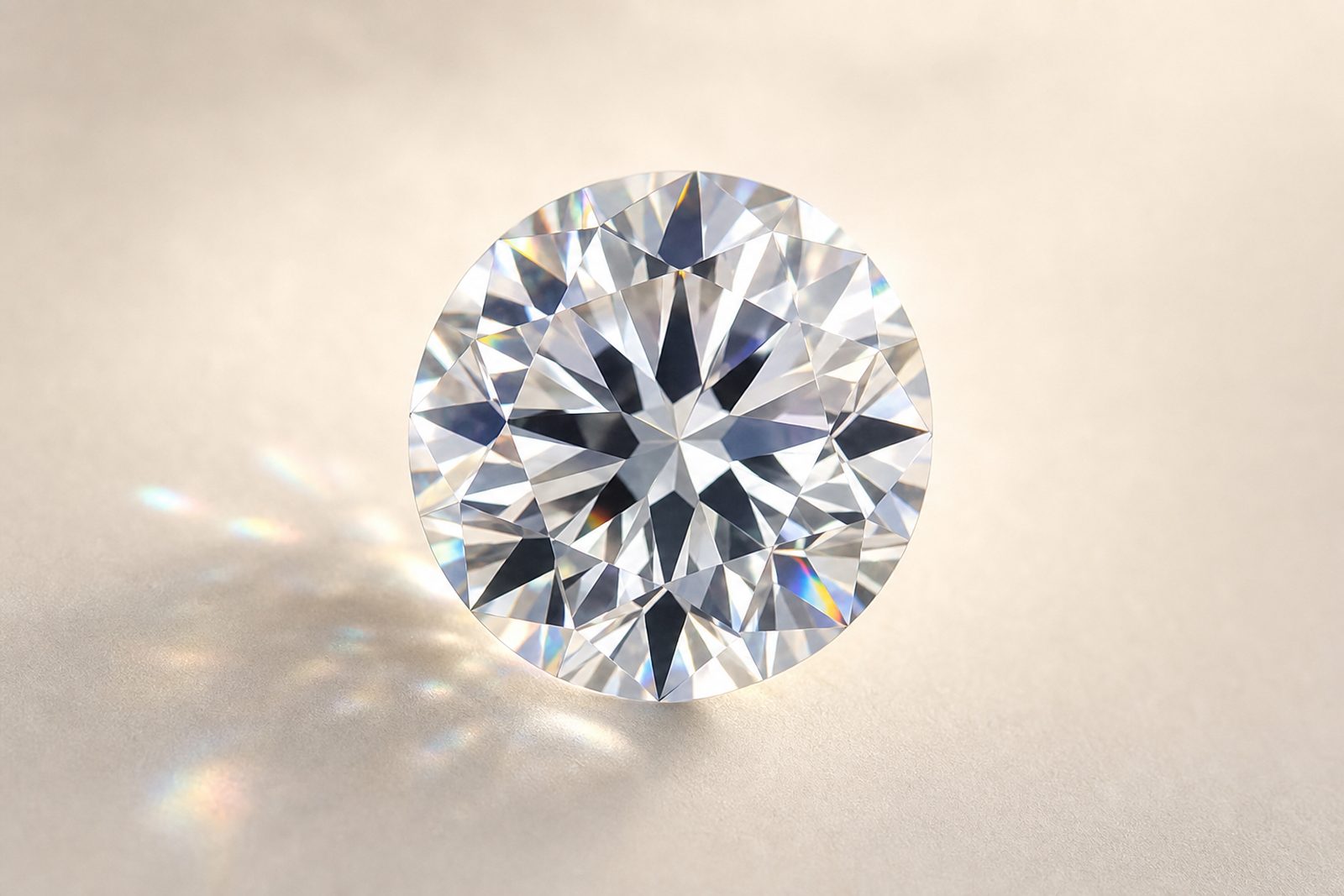
A 1 carat round brilliant is typically around 6.5 mm across. This is an orientation figure: use the chosen diamond’s report for its actual dimensions. Shape, depth and setting also affect its presence on the hand.
Choose the appearance, then compare the grades
- Cut and shape: compare the individual stone’s proportions and appearance. GIA’s overall cut grade applies to standard round brilliants in the D-to-Z colour range. Fancy shapes require their own assessment.
- Colour: compare the diamond in the metal and setting you intend to use. The grade is useful, but the colour you notice is a personal choice.
- Clarity: inspect visible inclusions, their position and any durability concerns. A VS or SI label alone does not establish that a stone is eye-clean.
- Carat and dimensions: weight is not face-up width. Compare the measurements on each report alongside the price.
Use our 4Cs guide and report-reading guide to prepare a shortlist. Ask to see available images or arrange a viewing.
Rapaport is a benchmark; your quote is for an individual diamond
The Rapaport Price List gives benchmark asking-price indications in US dollars. It is not a record of completed transactions or a universal consumer price. The actual stone, supply costs, exchange rate and seller’s terms affect a rand quote. Check all inclusions rather than comparing a discount percentage alone.
Prodiam cuts diamonds at Procut DCW and also sources polished stones through the certified trade. Buying directly does not establish a fixed saving against another seller. Compare the report, stone and complete VAT-inclusive quote. A ring setting and making are additional to a loose-diamond price: our quote comparison guide shows what to check.
1 carat diamond ring price in South Africa
A 1 carat diamond ring costs the centre diamond plus the setting, the metal and the making. In our 19 October 2026 sample, a natural one-carat diamond at H colour or better, VS2 clarity or better and an Excellent cut typically cost R77 600, and a J-colour stone at VS1–VS2 about R42 900, VAT and delivery for the loose stone included.
The setting depends on the design, the metal and how many smaller diamonds it carries, so we quote it with the stone rather than print a flat figure. For complete ring budgets by centre-stone size, see what an engagement ring costs in South Africa, or browse engagement rings in stock with their prices.
What moves the price of a 1 carat diamond
Use these factors alongside the dated sample above. The current quote must identify the actual diamond, its grades and all price inclusions.
| Factor | How it moves the price |
|---|---|
| Cut grade | Compare cut quality and appearance on the actual stone. GIA’s overall cut grade applies to standard round brilliants in its D-to-Z range. |
| Colour grade | Colour can change the price at comparable grades. Compare the appearance in your intended setting and the actual quotes. |
| Clarity grade | Higher clarity can command a premium. Inspect the individual inclusions; a grade alone does not guarantee an eye-clean stone. |
| Exact carat weight | The per-carat price steps up at the 1.00 ct threshold; a stone just under (e.g. 0.90 ct) looks the same face-up and can be quietly cheaper. |
| Rapaport list movement | A benchmark of asking-price indications, not completed transactions or the final price of every stone. |
| Rand–dollar exchange rate | Exchange rates and supply costs can affect the rand quote. Compare VAT-inclusive prices and confirm delivery and other inclusions. |
| Fluorescence & finish | Assess fluorescence, polish and symmetry with the individual diamond’s appearance and report; do not infer a fixed discount or resale value. |
| Supply route | Cut in-house at Procut DCW, or sourced to order from the certified trade. Compare complete quotes; the supply route alone does not prove a saving. |
Lab-grown vs natural, and what we sell
You will see one-carat lab-grown diamonds advertised at a small fraction of a natural stone’s price, and the gap is widening as lab-grown supply grows. They are real diamonds, chemically identical, and a legitimate choice, but they are a different product with a different value trajectory, and we are clear about which one we deal in.
Prodiam works in natural diamonds only. If you are weighing the two, our natural vs lab-grown vs moissanite guide lays out the differences honestly so you can decide before you ask us for a figure.
How to get your exact 1-carat figure
- 01
See live prices
Open the diamond search to see fully-landed ZAR prices and filter to your exact carat, colour, clarity and GIA Excellent cut. Shortlist anything that looks right.
- 02
Tell us the spec
Send your target grades and budget, or just say “a near-colourless, eye-clean one-carat round” and let us interpret it. We respond within 24 hours, by email, video or WhatsApp.
- 03
Firm quote in writing
We quote your chosen stone firm, in ZAR, including VAT, referenced to the Rapaport list, a real number for a real stone, not a range. Compare it against any retail quote for the same four grades.
- 04
Verify the certificate
Check the GIA report number yourself against the GIA report-check service. The grades on the paper are the grades you are paying for.
- 05
Buy loose or as a ring
Take the stone as a loose diamond or have it set into a custom ring — a carat stone this size suits a vintage, princess-cut or marquise setting particularly well, or browse every style we make. Delivered insured and overnight nationwide via Brink’s or G4S, with a written insurance valuation.
We are a director-led South African diamond dealer and cutting house, not a shopfront marking up someone else’s stones. If you want the honest answer on what your one-carat diamond should cost, the fastest route is to see the live prices and then ask Darren for a firm quote; he will come back within 24 hours.
1 carat diamond price: common questions
How much does a 1 carat diamond cost in South Africa?
For 1 carat diamonds in South Africa, our 19 October 2026 sample had a median of R60 800 at H colour. The middle half of sampled prices was R56 300–R66 200. This compares 0.95–1.09 ct stones at VS1–VS2 clarity, with an Excellent cut filter and no fluorescence. VAT and delivery for the loose stone are included; a setting is additional. Confirm the current price for your chosen diamond.
Why isn’t there one price for a 1 carat diamond?
Because “1 carat” is only the weight, one of four characteristics that set the price. Two diamonds that both weigh a carat can differ in value by several multiples depending on their cut, colour and clarity grades, and whether the cut is genuinely well made.
The international wholesale benchmark, the Rapaport price list, is itself a grid: it quotes a different per-carat figure for each colour-and-clarity combination at the one-carat size, and the polished diamond then trades at a discount or premium to that list depending on its exact make. Add the rand–dollar exchange rate on the day and you can see why a single “1 carat price” cannot exist.
The honest answer is a figure for your exact specification, which is why we quote firm, in writing, before any work begins.
Is a 1 carat diamond cheaper direct from a cutter than from a jeweller?
Ask us to compare the individual quotes. We cut some diamonds in-house and source others through the certified trade, so there is no fixed saving that applies to every stone. Compare the full VAT-inclusive price, laboratory report, measurements and service terms; we will explain how our selected diamond is priced.
What 1 carat diamond specification gives the best value in South Africa?
Start with the appearance you want and your total budget. For a round brilliant, compare the cut grade and actual dimensions; for a fancy shape, assess its proportions and appearance. Compare colour and clarity in the intended setting, and request images or a viewing to assess visible inclusions. A clarity grade alone does not guarantee an eye-clean 1 carat stone.
Are your 1 carat diamonds GIA certified?
Check the laboratory and report for the individual diamond. Prodiam sells natural diamonds; some are cut in-house and others are sourced as polished stones through the trade. A GIA report is verified with GIA, and another laboratory’s report with that laboratory. GIA gives an overall cut grade to standard round brilliants in its D-to-Z range, not every fancy shape.
Can I get a 1 carat diamond price if I’m not in Johannesburg?
Yes. Send your 1 carat specification and budget, and ask for the actual stone’s laboratory report and available photographs or video. Confirm the VAT-inclusive written quote, availability, sourcing lead time and insured delivery before committing. A complete ring also needs an agreed setting and production timeline.
How much is a 1 carat diamond worth if I sell it?
Less than it costs to buy one, because whoever buys it has to resell, re-set or re-cut it. A resale offer depends on the individual stone, its laboratory report and trade prices on the day, so there is no single resale figure for a 1 carat diamond. Prodiam buys natural diamonds, loose or set, and makes an offer on the actual stone: see selling diamonds and jewellery to Prodiam.
Last reviewed: October 2026. Prices captured 19 October 2026.