
Education · Buyers · 9 min read
The 4Cs of diamond grading, plainly explained.
Cut, colour, clarity, carat. The Gemological Institute of America formalised this taxonomy in the 1950s, and every reputable diamond report in the world uses it. The order most jewellers will not lead with, and the reason cut belongs at the top, is what this guide is about.
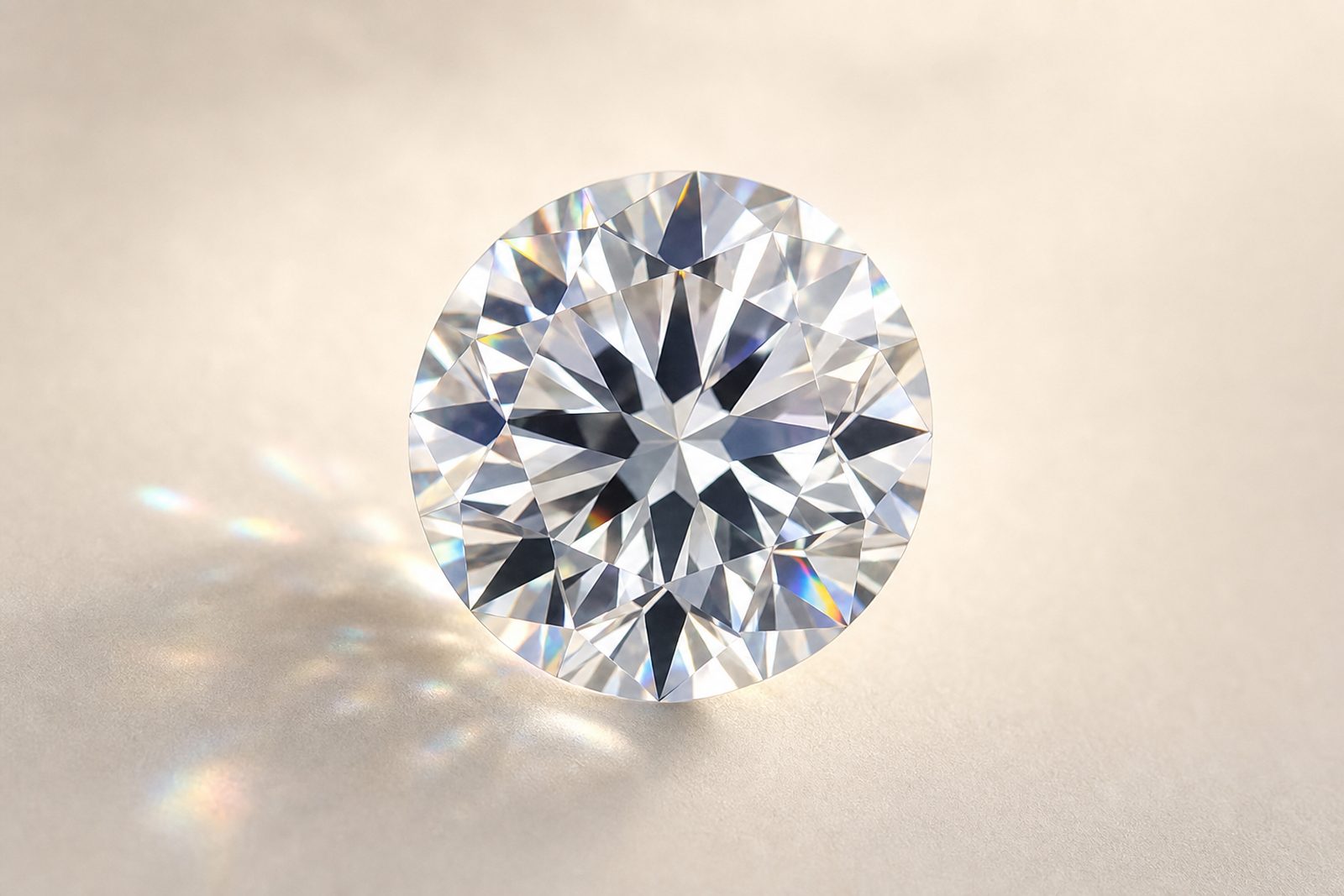
1. Cut, the only C the cutter sets
Three of the 4Cs are properties of the rough stone before anyone touches it. Colour is set when the diamond crystallises in the mantle. Clarity is set by the inclusions trapped during that crystallisation. Carat weight, in the rough, is set by how big the stone formed.
Cut is different. Cut is the only C that the cutter chooses, and therefore the only one with a craftsperson's name attached. It is the geometry that takes a piece of crystallographic luck and turns it into a stone that returns light to the eye. Done well, a 1.00 ct GIA-Excellent round brilliant looks like a small searchlight. Done poorly, the same rough yields a stone that swallows light and looks dead at arm's length.
The GIA cut scale, for round brilliants, runs Excellent / Very Good / Good / Fair / Poor. The American Gem Society (AGS) runs its own separate top-grade scale. Most reputable houses cutting for the SA and international trade aim at GIA Excellent on the round-brilliant proportion ranges set out below.
Working ranges for round brilliant cut
| Attribute | Working range |
|---|---|
| Total depth | 59.0 – 62.5% |
| Table | 54 – 58% |
| Crown angle | 34.0 – 35.0° |
| Pavilion angle | 40.6 – 41.0° |
| Crown height | 14.4 – 16.2% |
| Pavilion depth | 42.5 – 43.5% |
| Star length | 50 – 55% |
| Lower-half facets | 75 – 80% |
| Girdle | Thin to slightly thick (faceted) |
| Culet | None to very small |
| Polish & symmetry | Excellent or Very Good |
Stones inside these ranges, with Excellent or Very Good polish and symmetry, generally earn GIA Excellent. Outside them, light leaks from the pavilion or returns unevenly across the crown.
Fancy shapes (oval, pear, marquise, princess, emerald, cushion, asscher, radiant, heart) do not currently receive a GIA cut grade. GIA reports them as polish and symmetry only. For a fancy, the bench judgement of light performance, the loupe-and-microscope test in person, matters more than any single number on the report. The GIA report walk-through shows where to look, and our guide to choosing a diamond shape covers what each shape is best for.
For the full picture, how the GIA cut scale works, the proportion ranges that earn an Excellent grade, and why a well-cut stone outperforms a larger poorly-cut one, read our complete guide to diamond cut.
2. Colour, D to Z, but only D to K matters
Diamond colour is graded D (colourless) through Z (light yellow or brown). Beyond Z is the territory of fancy coloured diamonds, which are graded on a separate scale that rewards saturation rather than the absence of body colour.
For colourless white-gold or platinum settings, the practical decision points are:
- D – F (colourless). No detectable body colour even by a trained grader. The price premium over G-H is real and largely emotional rather than visual.
- G – J (near colourless). Eye-clean colour in any setting. G-H is indistinguishable from D-F to the unaided eye and saves materially over D-F.
- K – M (faint yellow). Body colour starts to show face-up in white metal. In yellow gold, K and L can disappear into the metal and represent excellent value.
- N – Z. Visible body colour. Niche use, often as a deliberate warm aesthetic.
The single highest-leverage colour decision in a budget-bound purchase is dropping from D-E-F to G or H. A G-VS1 stone in a platinum setting reads identical to D-VS1 to the unaided eye across a viewing room, and the saving funds either a larger stone or a better cut grade.
Our guide to diamond colour works through the D-to-Z scale grade by grade, with the white-metal and yellow-gold decision points laid out in full.
3. Clarity, what 10× magnification reveals
Clarity grades describe the size, type and position of internal inclusions and surface blemishes seen at 10× magnification by a trained grader. The scale, top down:
| Grade | What you see at 10× | What you see at arm's length |
|---|---|---|
| FL / IF | Nothing internal (FL also nothing external) | Nothing |
| VVS1 / VVS2 | Minute inclusions, hard to find at 10× | Nothing |
| VS1 / VS2 | Minor inclusions, visible at 10× under loupe | Nothing in well-cut stones |
| SI1 | Inclusions noticeable at 10× | Usually eye-clean; check the plot |
| SI2 | Inclusions readily noticeable at 10× | Sometimes visible to the careful eye |
| I1 / I2 / I3 | Obvious at 10×; often affects durability | Visible |
The trade short-hand "eye-clean SI" matters because most buyers cannot tell a VS2 from an SI1 across a viewing-room table, and the price difference is large. The bench test for eye-clean SI1 or SI2:
- Pull the GIA plot from the report. Note where the inclusions sit.
- Hold the stone face-up under the daylight-balanced viewing light, 30 cm from the eye.
- If you cannot find the inclusions in 10 seconds without magnification, the stone is eye-clean.
Inclusion position matters as much as the grade. A small black crystal under the table is more visible than a feather near the girdle, even if the GIA grade is the same. A working bench reads the plot before quoting.
The full diamond clarity guide covers every grade from Flawless to I3, how inclusions are plotted on a GIA report, and when an eye-clean SI stone is the smarter buy.
4. Carat, and why "shy" weights win
One carat is 0.20 g. The diamond-pricing market has long been organised around magic numbers, 0.50, 0.90, 1.00, 1.50, 2.00, 3.00 ct, at which per-carat prices step sharply upwards because demand is anchored on the round figure. Stones that fall just below those magic numbers (0.96 ct, 1.94 ct) trade at materially lower per-carat prices than stones that just clear them.
These under-shooting weights are called shy stones. A 0.96 ct GIA-Excellent G-VS1 round brilliant will be visually indistinguishable from a 1.00 ct of the same grade across a viewing room (the diameter difference is under 0.1 mm) and will price 5-12% lower per carat. The same logic operates at every magic-number tier.
For a custom engagement ring, the better answer is almost never "buy the smallest stone you can stretch to one carat." It is "buy the largest stone you can stretch to in the shy weight below the next magic number." That is how a SA cutting house thinks about budget.
Our full guide to diamond carat covers how weight translates into face-up size, the magic-number and shy-weight pricing in detail, and how a deep or shallow cut hides or wastes carat.
5. The real trade-offs in a real budget
On a fixed budget, the four grades trade against each other constantly. The order in which a serious bench will sacrifice:
- Drop colour first, from D-E-F to G or H. Largest visible savings for the smallest visible loss in a white-metal setting.
- Drop clarity next, from VS to eye-clean SI1. Read the plot before agreeing.
- Choose a shy carat weight. 0.96 instead of 1.00; 1.94 instead of 2.00.
- Never drop cut. Cut is the one variable you cannot change after the stone is cut, and the one your eye notices first.
Working through that order on a single stone, against a real budget, is what a one-hour viewing at the Bedfordview viewing room is for. The same building houses GIA South Africa for re-grading on request; the GIA report walk-through teaches you to do the loupe check yourself; the wholesale-vs-retail guide shows you how the market prices each step of the trade-off.
Frequently asked questions
Which of the 4Cs matters most?
Cut, by a long way. Cut governs how the stone returns light. A poorly cut diamond at higher colour and clarity will look smaller, duller and worse than a well-cut diamond a grade or two below it on colour and clarity. The first decision should be cut grade; the others trade against budget around it.
Is GIA Excellent the top cut grade?
For the round-brilliant cut, yes. GIA's top cut grade is "Excellent", and Prodiam cuts every centre stone to it. Other gem laboratories run their own top-grade scales with different methodologies (some grade cut by light return, others by proportion), but the practical test does not change: maximum brightness, fire and even contrast in the hand.
What carat weight is best value?
Buyers undershoot magic numbers (0.50, 0.90, 1.00, 1.50, 2.00 ct) for value. A 0.96 ct stone often costs noticeably less per carat than a 1.00 ct stone of the same colour, clarity and cut, and it looks the same to the naked eye. The trade calls these "shy" weights.
What is the lowest colour grade you should accept?
It depends on the metal. In white gold or platinum, G or H is generally indistinguishable from D-E-F to the eye and saves real money. Below I, warmer body colour starts to show. In yellow gold, you can drop further (J, K) without visual penalty because the metal disguises the warmth.
Are SI clarity stones eye-clean?
Often yes for SI1; sometimes no for SI2. The grade describes inclusions seen at 10× magnification, not at arm's length. The bench check is to look at the GIA plot, identify the inclusions, then look at the stone face-up under daylight at 30 cm. If you cannot see them there, the stone is eye-clean for that grade.
What does "fluorescence" mean and does it matter?
Some diamonds glow under UV light because of nitrogen-related atomic defects in the crystal (the N3 centre); this is fluorescence. Strong blue fluorescence in a colourless (D-F) stone can occasionally cause a milky or hazy appearance in sunlight. In near-colourless stones (G-J) faint to medium fluorescence is generally neutral, and in lower colour stones it can slightly mask body colour and improve the face-up appearance.
Should I prioritise carat or cut?
Cut. A 0.90 ct GIA-Excellent stone will face up larger and brighter than a 1.10 ct GIA-Good stone of the same colour and clarity, and will hold its value better. The cut grade is also the one variable you cannot change after the stone is cut.
What about depth and table percentages?
For round brilliants the workable ranges are roughly: total depth 59-62.5%, table 54-58%, crown angle 34-35°, pavilion angle 40.6-41°. Inside those ranges most stones cut by a careful house will return light well and earn a GIA Excellent cut grade. Outside them, light leaks out the bottom or the sides.
Next
Once cut, colour, clarity and carat are clear, the next layer is reading the certificate that proves them. Read the GIA report walk-through →