
Education · Certification · 12 min read
How to read a GIA Diamond Grading Report, line by line.
A GIA Diamond Grading Report is the most cited document in the global diamond trade. The report itself is short, typically a single page on heavy security paper, plus a digital archive at gia.edu, but every line on it has been written to a strict protocol and every line is meaningful. This is how the cutting bench reads one.
1. Verify the report number first
Before anything else, take the report number printed on the certificate and check it on the GIA Report Check service at gia.edu/report-check. The lookup returns the same grading data that appears on the printed report. If the printed numbers and the online numbers do not match exactly, stop. The certificate is either out of date, mismatched, or fraudulent.
Counterfeit certificates exist. Real GIA reports also exist for stones that have since been re-cut, re-polished, or damaged after grading. Either way, the stone in front of you no longer matches its report and the report should not be trusted.
At Prodiam every loose stone is checked against GIA Report Check at intake and again at hand-over. The same building as our viewing room houses GIA South Africa for re-grading on request, on the same address.
2. Identification & weight
The identification block at the top of the report carries:
- Report number. A unique GIA reference, eight to ten digits. Used for verification, lookup, and laser inscription.
- Shape and cutting style. Round brilliant, princess (square modified brilliant), oval brilliant, and so on.
- Measurements. Three dimensions for round (min diameter × max diameter × depth, in millimetres). Length × width × depth for fancies.
- Carat weight. To two decimals (0.01 ct) on standard reports.
- Date. The day the report was issued.
For round brilliants the length-to-width ratio derived from the first two measurements should be 1.00 to 1.01. Anything beyond 1.02 is meaningfully out of round. For fancies, the ratio is part of the shape's character: oval typically 1.30-1.50, pear 1.45-1.75, marquise 1.85-2.10.
3. Grading results, the four grades
Four lines, in this order: colour grade, clarity grade, cut grade (round brilliants only), and depending on the report type, an overall finish line. Each grade is set by a panel of GIA graders working under standardised lighting and double-blind protocols.
The grade values are the same vocabulary as in the 4Cs guide: D-Z for colour; FL through I3 for clarity; Excellent through Poor for cut, polish and symmetry. There is no editorial language, the report says what the panel found and nothing else.
4. Proportions diagram
On the right of the report is a schematic profile diagram of the stone, with measured proportions labelled around it. Working through it from top to bottom for a round brilliant:
| Field | Working range | What it does |
|---|---|---|
| Table % | 54-58 | Top facet diameter as % of girdle diameter. Bigger table, broader light return; smaller table, more crown fire. |
| Crown angle | 34-35° | Steeper crown lifts fire; shallower crown lifts brilliance. |
| Crown height % | 14.4-16.2 | Vertical height of the crown as % of girdle diameter. Tied to crown angle. |
| Pavilion angle | 40.6-41.0° | Most sensitive single angle in a round brilliant. Outside this range, light leaks. |
| Pavilion depth % | 42.5-43.5 | Vertical depth of the pavilion as % of girdle diameter. |
| Total depth % | 59.0-62.5 | Crown + girdle + pavilion. Above 63%, weight is hidden in depth instead of spread. |
| Star length % | 50-55 | Length of the star facets relative to bezel facets. |
| Lower-half % | 75-80 | Length of the lower-half facets relative to the pavilion main. |
| Girdle | Thin to slightly thick | Faceted girdle preferred; bruted girdles are older work. |
| Culet | None to very small | Open culet on modern rounds is uncommon and often penalised. |
The proportions are the part of the report a working cutting house reads first after the grade summary. Together they tell you whether the stone has been cut for spread (face-up size) or for weight retention from the rough. Cuts optimised for weight rather than light return often carry deeper totals, thicker girdles, and slightly off-range pavilion angles.
5. Finish, polish and symmetry
Polish describes the smoothness of the polished surface; symmetry describes the geometric alignment of facets. Both are graded Excellent / Very Good / Good / Fair / Poor.
For a centre stone in a fine setting both should read Excellent or Very Good. A Good polish or symmetry, especially in combination, dulls the optical performance even when the proportions are otherwise within range, and is the most common quiet downgrade on stones cut for weight retention.
6. Fluorescence
Diamonds may glow under long-wave ultraviolet light because of nitrogen-related atomic defects in the crystal (the N3 centre); this is called fluorescence and grades None / Faint / Medium / Strong / Very Strong, usually with a colour (most commonly Blue).
The market premium for None over Faint or Medium is real but in most cases not visually justified. Strong Blue fluorescence in a colourless (D-F) stone can very occasionally produce a milky or hazy appearance in sunlight. Below F (G-J) Strong Blue is generally neutral or a small cosmetic plus. In K-M stones, Faint to Medium Blue helps mask body colour face-up.
7. The clarity plot
On the lower portion of standard GIA reports is a labelled plot of the stone's crown and pavilion, with each inclusion and blemish marked. Red marks describe internal characteristics (crystals, feathers, pinpoints, clouds, needles, twinning wisps); green marks describe external characteristics (naturals, indented naturals, polish lines, abrasions, nicks).
Two stones with the same clarity grade can read very differently in the plot. A single small crystal under the table is more visible than three pinpoints scattered near the girdle. Read the plot first, then look at the stone:
- Identify each inclusion's type from the plot legend.
- Locate it in the schematic.
- Predict where on the real stone it should sit (face-up vs side, table-zone vs girdle-zone).
- Look through the loupe and confirm.
If the plot says one feather under the bezel and you find three crystals under the table, the report does not match the stone. Stop.
8. Laser inscription
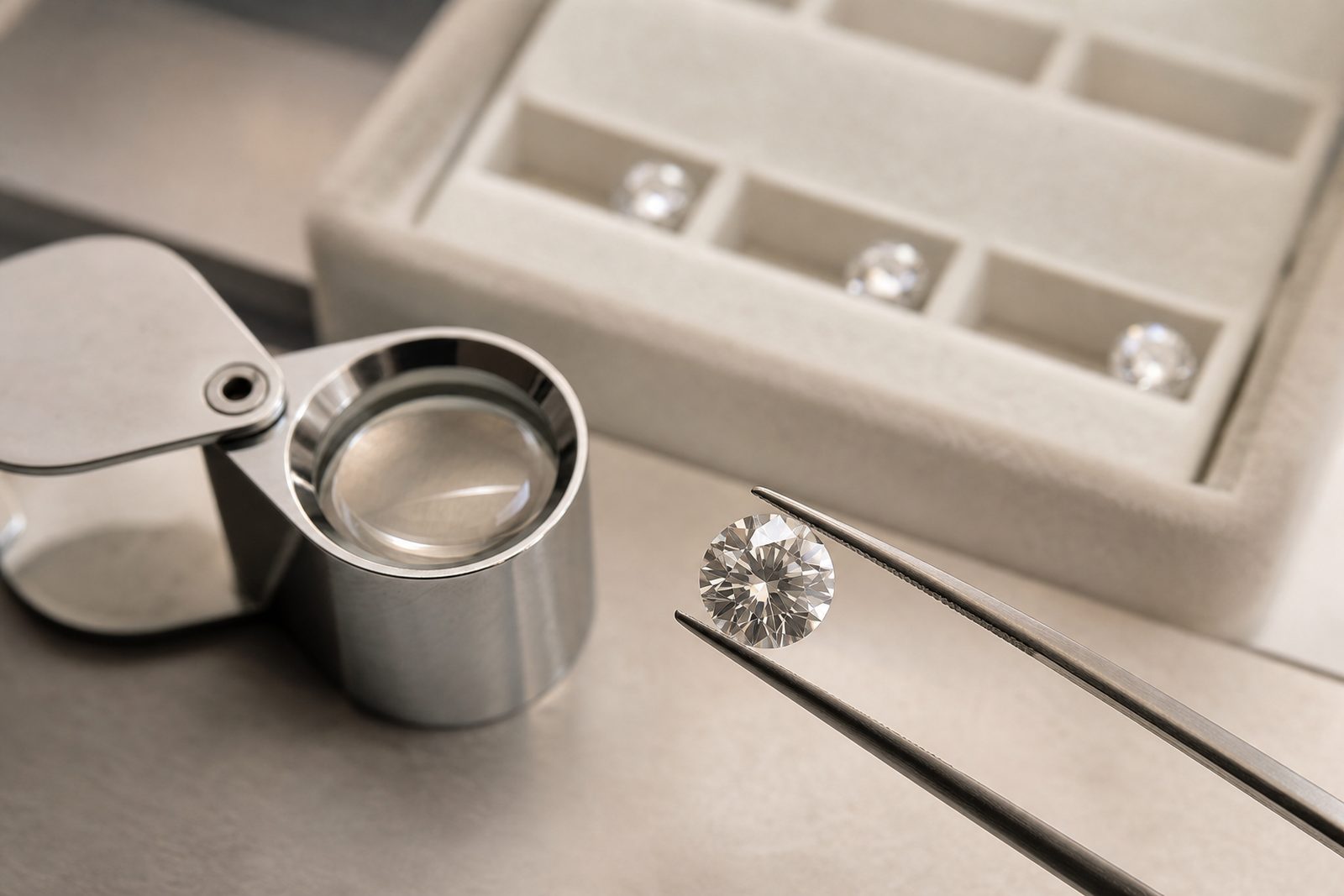
On stones above 0.30 ct, GIA laser-inscribes the report number on the girdle of the polished stone. The inscription is invisible to the naked eye but readable at 10× under a loupe with the stone girdle-up.
Matching the inscription to the report number is the single most powerful verification step a buyer can perform. If the report number on the certificate matches the inscription on the girdle, and the GIA Report Check lookup matches both, the stone in front of you is the stone the report describes.
If you would rather have a professional check it, our note on diamond verification in South Africa sets out how to get an independent second opinion before you pay.
At hand-over the bench presents stone and certificate together, points the inscription out under loupe, and signs the certificate across with the date. That signed cross-page is your evidence of correspondence. Keep it.
9. Comments & treatment disclosure
Below the grading results sits a Comments line. This is where GIA discloses anything not captured by the standard fields: clarity-treatment status, HPHT processing, surface coating, colour origin notes, and similar.
For a natural untreated diamond the comment line is short and the report does not flag treatment. For treated stones the report carries explicit language; treated stones also receive a different report type (Identification & Origin Report in some cases, with treatment status disclosed). Read this line carefully on any older or unusual stone.
10. Report types and what they include
- Diamond Grading Report. Full assessment, plot, proportions, all four Cs, fluorescence, finish. Standard for stones over 1.00 ct.
- Diamond Dossier. Compact format, no plot, all Cs and proportions present. Standard for stones 0.15-1.00 ct.
- Diamond eReport. Digital-only equivalent of the Dossier.
- Coloured Diamond Grading Report. Used for fancy coloured diamonds. Reports colour intensity (Faint through Vivid) and colour origin (Natural / HPHT-treated / Irradiated).
- Lab-Grown Diamond Report. Identifies the stone as laboratory-grown and grades it on the same 4C scale.
Prodiam works in natural diamonds only. See our neutral comparison guide for why the segments are different products with different value curves.
Next
Once cert and stone correspond, the next question is what the market actually charges for the grades on it. Read the wholesale-vs-retail pricing guide →