
Education · Buyers · 10 min read
Natural vs. lab-grown vs. moissanite: a neutral comparison.
Three different products, three different markets, three different value curves. None of them is fake; none of them is universally superior. The honest answer to "which should I buy?" depends on what you want the stone to do for you over the next twenty years.
1. What each one actually is
| Product | Material | Origin |
|---|---|---|
| Natural diamond | Carbon crystal lattice (C) | Formed under heat and pressure 1-3 billion years ago in the Earth's mantle, brought to surface by kimberlite eruption. |
| Lab-grown diamond | Carbon crystal lattice (C), chemically identical to natural | Grown in a laboratory by Chemical Vapour Deposition (CVD) over weeks, or by High-Pressure High-Temperature (HPHT) over days. |
| Moissanite | Silicon carbide (SiC), different mineral entirely | Synthesised under licence (originally Charles & Colvard) since 1998. Trace natural moissanite was discovered in meteorite remnants in 1893. |
Natural and lab-grown diamonds are the same material with different origin stories. Moissanite is a different material altogether, chemically, optically, and on the Mohs hardness scale.
For graded jewellery in 2026, both natural and lab-grown diamonds are reported by GIA, IGI and other major laboratories on the same 4C scale (cut, colour, clarity, carat). Lab-grown reports explicitly disclose the laboratory-grown origin and the growth method (CVD or HPHT).
2. How they compare visually
At a viewing-room table, under loupe and microscope:
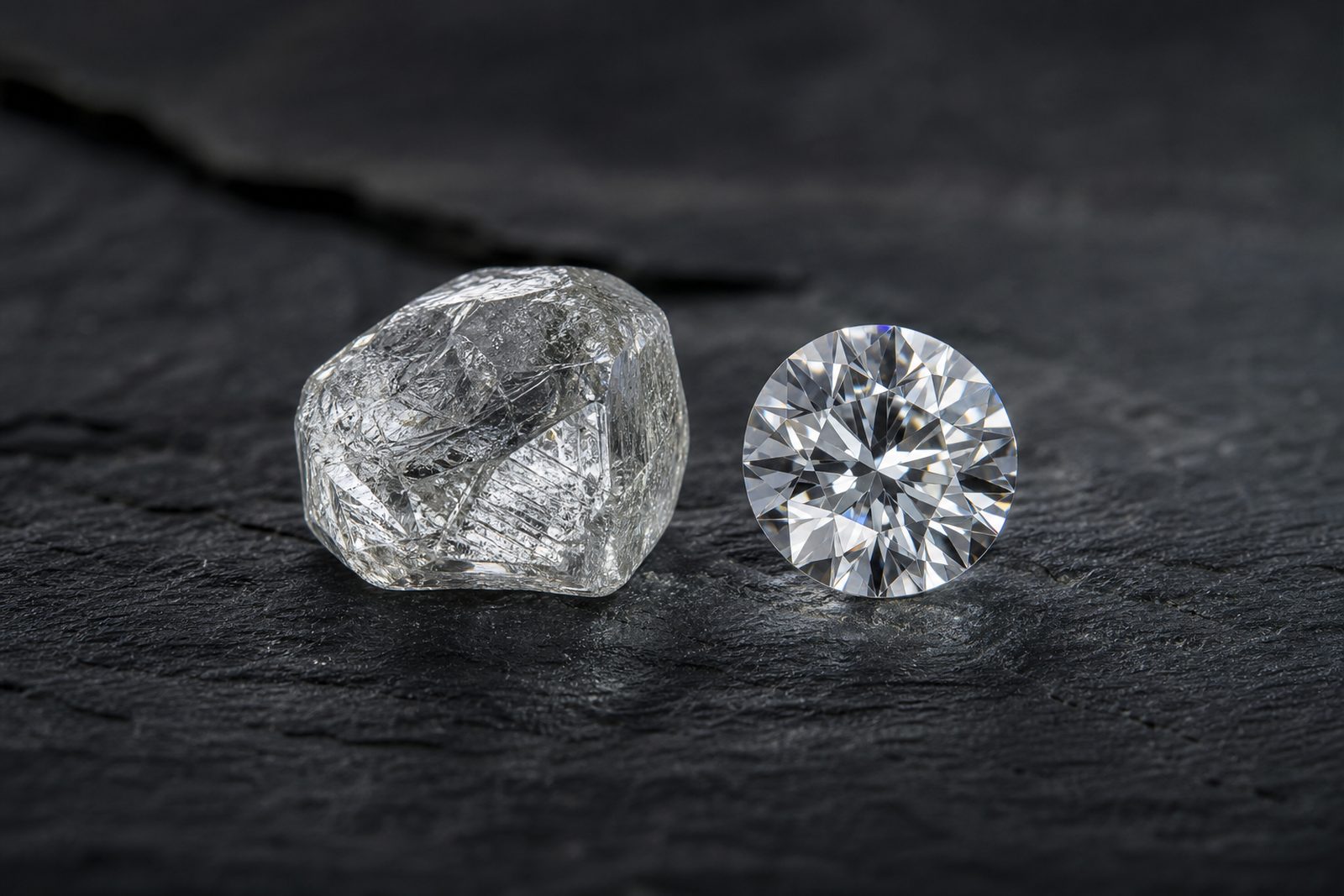
- Natural and lab-grown diamonds are visually identical. No naked-eye test distinguishes them. Trained gemmologists use DiamondView, FTIR or photoluminescence spectroscopy to identify the growth signatures, but a loupe alone cannot.
- Moissanite shows visibly more "fire", rainbow-coloured flashes, because its refractive index (~2.65) is higher than diamond's (2.42). This is sometimes a feature, sometimes a tell, depending on aesthetic preference.
- Moissanite is also doubly refractive. Looking through the table at the pavilion facets at the right angle shows visible doubling of the facet edges. Diamond is singly refractive and never shows this.
- On the Mohs hardness scale, diamond is 10 (the reference), moissanite is 9.25, and other simulants (cubic zirconia, white sapphire) are 8.5 or lower. All three of these (natural, lab-grown, moissanite) are durable enough for daily wear over decades.
3. How prices have moved (2020 to 2026)
The most consequential market story of the past five years is the price collapse in lab-grown diamonds. As CVD and HPHT production capacity scaled (most aggressively in China and India) wholesale lab-grown prices have fallen approximately 70-90% from 2020 to 2025.
| Stone (1.00 ct, G-VS1, round, GIA-graded) | 2020 wholesale, USD/ct | 2025 wholesale, USD/ct | Movement |
|---|---|---|---|
| Natural diamond | ~4,800 | ~4,000 | Held within a normal band |
| Lab-grown diamond | ~4,000 | ~500 | -87% |
Figures are working trade estimates from polished-trade services and SA cutting-house intake records, rounded for clarity. Specific stones move with grade nuance and timing. Treat as direction, not an exact quote.
In retail, the same dynamic plays out one or two layers downstream. A 1.00 ct lab-grown G-VS1 ring that retailed in 2020 at the equivalent of R 60,000-80,000 commonly retails today at R 9,000-12,000 for the same grade and setting. Natural-diamond retail has not moved similarly.
Moissanite has held a relatively stable 1.00 ct equivalent retail of roughly R 4,000-12,000 across that window, because its production base was already mature and its market is its own.
4. The resale curve over twenty years
Resale is where the segments diverge most sharply. A twenty-year-old GIA-Excellent natural diamond bought from a reputable house typically resells, today, at 30-60% of its original retail price, discounted, but on a real secondary market with real buyers. The Rapaport list still applies. A cutting house, a tender, or a specialist buy-back desk will give a real price.
A twenty-year-old lab-grown stone has no comparable resale market today, and the production-side curve suggests the 2026 stone will resell in 2046 at a small fraction of even its now-discounted retail. Most retail jewellers refuse lab-grown trade-ins outright; the few that accept them usually offer melt-equivalent or lab-grown-replacement-cost terms.
Moissanite is not a resaleable jewellery asset. Buy-back offers are essentially zero. The buyer is purchasing the stone and the setting, not a stake in the secondary market.
Resale is not the only metric, but it is the metric that most aligns "what you paid" with "what someone else is willing to pay later". For a buyer who treats the stone as a wearable asset over decades, the curve matters. For a buyer who treats it as one-time apparel, it does not.
5. Ethics, sustainability, and the Kimberley Process
Lab-grown marketing leans heavily on an ethics narrative. The reality is more layered and more interesting than the slogans on either side suggest. The thumbnail:
- The 1990s "blood diamond" concerns drove the Kimberley Process Certification Scheme, which has substantially reduced the share of conflict rough in international trade.
- Formal-sector producers operating under multi-stakeholder best-practice frameworks (De Beers, Rio Tinto, Petra Diamonds, BHP and others operating outside the current sanctions regime) document chain-of-custody from mine to rough invoice. Rough sourced through this system is end-to-end traceable in ways the small-scale alluvial sector still is not. Russian-origin rough (the largest single source by volume historically) is excluded under UK and US sanctions; Prodiam does not source it.
- Lab-grown production is energy-intensive, most production uses grid electricity in countries with predominantly fossil-fuel mixes. The carbon footprint of CVD/HPHT diamonds is comparable to mined diamonds on a per-stone basis, and the renewable-only claims that some retailers make should be treated as marketing unless there is an on-site PPA or comparable evidence.
- South African beneficiation under the Diamonds Act 1986 adds a layer above and beyond the Kimberley Process: it mandates in-country cutting, majority-SA-citizen ownership, and explicit local-economic-uplift conditions for licensed manufacturers. See the SA beneficiation explainer.
Honest answer: both segments have legitimate sustainability work to do. Neither has a clean monopoly on ethics. The documentation a buyer should ask for, regardless of segment, is provenance, the chain from origin to till, not a slogan.
6. Which one fits which buyer
| If your priority is... | Best fit |
|---|---|
| Long-term value retention; a stone you can pass on or trade up later | Natural diamond |
| The largest visible stone for the lowest immediate price; not concerned about resale | Lab-grown diamond |
| Aesthetic of strong fire and a non-diamond character; smallest budget | Moissanite |
| Heirloom or upgrade context; existing diamond jewellery in the family | Natural diamond (compatible with re-mount and re-cut work) |
| Investment-grade or larger-stone purchase | Natural diamond (the only one of the three with a deep secondary market) |
| A specific stone with bespoke design but tightly capped budget | Either lab-grown or natural at a shy weight; the design fee dominates either way |
7. Where Prodiam stands
Prodiam is a natural-diamond-only house. Every stone we cut, polish, certify and sell is a natural diamond, on a GIA or EGL report, polished at our Bedfordview bench. We do not stock or sell lab-grown stones, moissanite, or any simulant.
That choice is structural, not a judgement of other segments. Our business is built around the De Beers DBCM Emerging Beneficiation Customer relationship, the SA Diamonds Act manufacturing licence, the Procut DCW cutting bench, and the long-term value curve of natural diamonds. A lab-grown stone is a different product for a different buyer with a different goal.
If the right answer for you is a lab-grown or moissanite stone, we will say so directly and recommend a specialist. If the right answer is a natural diamond, we are the cutting house in the country with the shortest chain between rough and your finger, whether you commission an engagement ring with us or simply take the loose stone.
Frequently asked questions
Are lab-grown diamonds "real" diamonds?
Chemically and crystallographically, yes. A laboratory-grown diamond produced by CVD or HPHT is the same carbon crystal lattice as a mined diamond and behaves identically under standard testing. Optically and to the eye there is no difference. The differences are in origin, market structure, and resale value, not material identity.
How do you tell a natural from a lab-grown diamond?
Trained gemmological screening tools (DiamondView, certain spectroscopy units) detect the growth signatures that distinguish natural from CVD or HPHT material. A loupe alone will not. Both GIA and IGI grade lab-grown diamonds and disclose their origin explicitly on the report. Any reputable sale of a lab-grown stone in 2026 ships with a lab-grown report; any sale of a natural stone ships with a natural-diamond report.
What is moissanite, and how does it differ from a diamond?
Moissanite is a separate mineral, silicon carbide (SiC), not carbon, engineered by Charles & Colvard since the late 1990s for jewellery use. It has a higher refractive index than diamond, which produces more "fire" (rainbow flashes) and a different visual character. It is meaningfully harder than other simulants but softer than diamond. It is a different product that has its own market and price.
Have lab-grown diamond prices really fallen that much?
Yes. Lab-grown diamond wholesale prices have fallen approximately 70-90% from 2020 to 2025 as production capacity scaled (particularly in China and India) and the supply curve flattened. A 1.00 ct lab-grown G-VS1 round that wholesaled for around USD 4,000 in 2020 commonly trades for USD 400-600 in 2025. Natural diamond prices over the same window moved within a normal market band of -10% to +10%.
What about resale value?
Natural diamonds have a thirty-year secondary market with established trade prices benchmarked to Rapaport. A 1.00 ct GIA-Excellent natural stone bought ten years ago typically resells today at 30-60% of its original retail price. Lab-grown diamonds do not yet have an established resale market; informal trade-ins are typically priced at metal-value-equivalent or refused outright by retailers. Moissanite has effectively no resale market at all.
Is lab-grown more "ethical"?
Lab-grown marketing leans on this claim. The full picture is more nuanced. Modern natural-diamond mining under Kimberley Process and the De Beers Best Practice Principles has materially fewer human-rights concerns than the small-scale alluvial sector of the 1990s; SA beneficiation under the Diamonds Act 1986 has explicit local-economic-uplift conditions. Lab-grown production is energy-intensive and concentrated in countries with mostly fossil-fuel grids.
Both segments have legitimate sustainability work to do; neither has a clean monopoly on ethics.
Why does Prodiam not stock lab-grown stones?
It is a strategic choice, not a moral one. Prodiam is a natural-diamond house. The whole operation is built around the De Beers DBCM Emerging Beneficiation Customer status, the Procut DCW cutting bench, and the long-term value curve of natural stones. A lab-grown stone fits a different buyer with a different goal. We will direct lab-grown enquiries to specialists rather than provide a half-hearted version of someone else's product.
Next
For natural-diamond buyers wanting the chain of evidence behind their stone: read the SA beneficiation explainer →