
Pricing · Market · 11 min read
Wholesale vs. retail diamond pricing in South Africa.
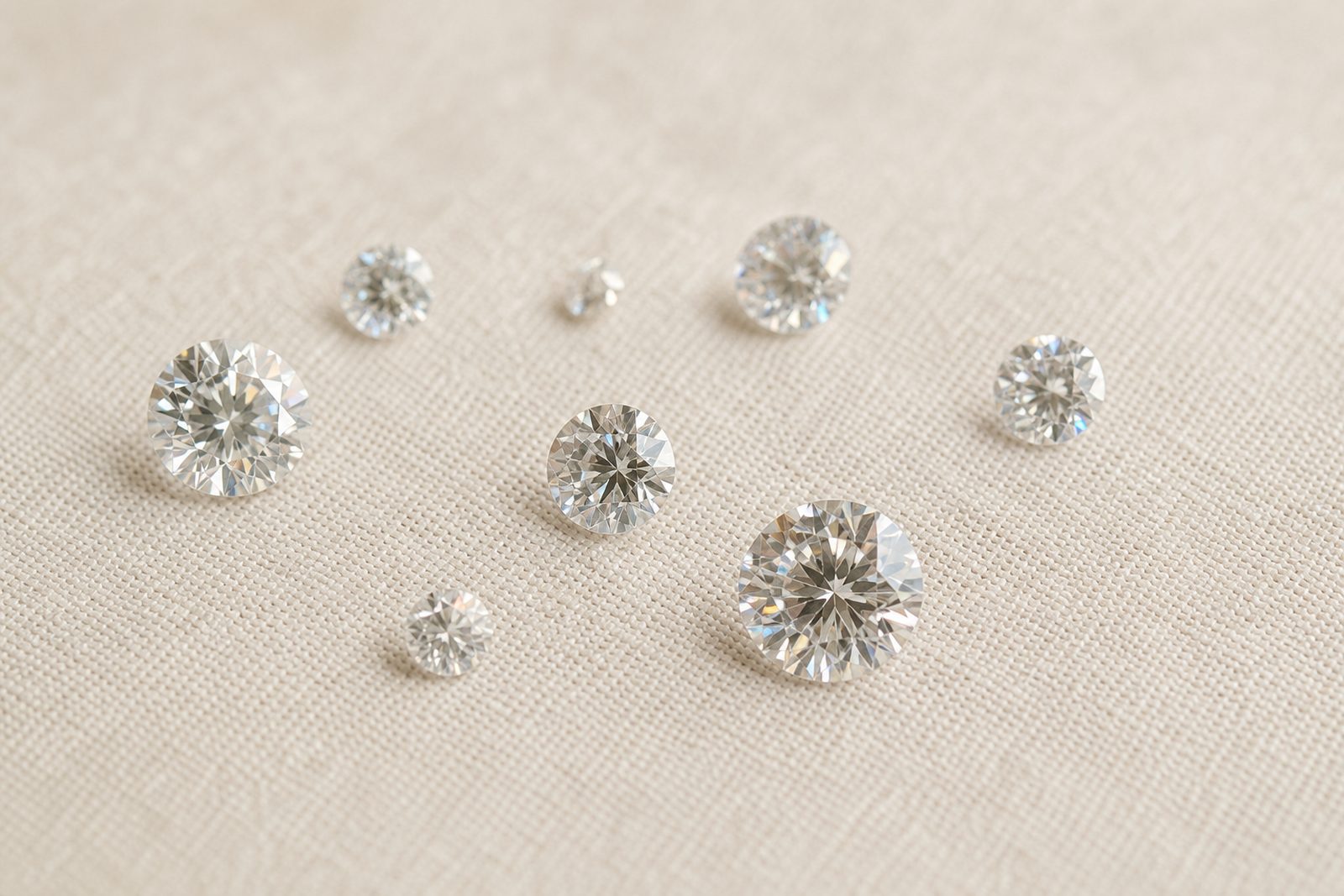
The same GIA-Excellent 1.00 ct G-VS1 round brilliant can be priced at R 70 000 in one shop and R 130 000 in another, on the same day, on the same Rapaport reference. The difference is not the stone. The difference is how many layers of margin sit between the rough and the till.
1. The Rapaport list, the trade's reference price
Every Friday since 1978, Martin Rapaport's New York office has published the Rapaport Diamond Report: a price list of US-dollar-per-carat figures for round-brilliant and pear-shape natural diamonds, by size band and grade combination.
The list is presented as a high-water-mark price for top-of-grade stones, and almost every wholesale invoice in the global trade is quoted as "Rap minus X%", a discount off the listed figure that reflects what an actual polished stone is worth.
For example, a 1.00-1.49 ct G-VS1 round on the Rap list might carry a listed reference of, say, $9,500/ct. A typical well-cut stone of that grade trades at Rap minus 25% to Rap minus 35% wholesale, putting the actual per-carat figure at roughly $6,200 to $7,100 wholesale. The list is the scaffolding; the discount is where the market lives.
The trade also uses non-Rap reference services (IDEX, Mercury Diamond, RapNet listings, EDIQS) that produce real-time polished-trade prices. The core dynamic is identical: a ceiling price plus a discount that reflects market.
2. The layers between rough and till
A diamond mined in Botswana, Russia, Canada or South Africa and sold to a South African retail customer typically passes through several distinct economic stages. Every stage takes a margin. The classical chain:
| Stage | What happens | Typical added margin |
|---|---|---|
| Mine | Rough extraction; sale to a Sightholder, Beneficiation Customer, tender, or auction. | n/a (cost basis) |
| Rough buyer | Selects, plans the cut, takes inventory risk on the rough until polished. | 5-15% |
| Cutter / polisher | Cleaves, blocks, brillianteers, polishes. Pays for skilled labour, weight loss, and certification. | 10-25% |
| Polished wholesaler | Holds polished inventory for the trade; quotes off Rap. | 5-15% |
| Importer / agent | Brings stones into a retail market; handles duties, currency, customs. | 5-15% |
| Retail jeweller | Display, brand, store overheads, sales staff, advertising. | 40-120% |
Compounded together, the cumulative markup from rough cost to retail price for a typical engagement-grade purchase through this kind of chain commonly runs in the 100-200% range over polished wholesale cost. The figures cited here sit within the published international ranges from Bain & Company, JCK, and McKinsey across the last decade.
The single largest layer in that chain is the retail margin itself, typically 60-120% at chain level or 80-150% at boutique level (industry-published ranges). The other layers are smaller individually but non-negligible together.
3. How the South African retail market actually prices diamonds
South Africa is a producer country with a small but well-organised cutting industry, a domestic Diamonds Act and beneficiation programme, and a retail jewellery sector that for thirty years was essentially three to four chain groups plus a long tail of independents and boutiques.
The chains operate on a high-volume / high-margin model with store networks of 50-300 outlets. The list price on a certified diamond ring at a chain typically reflects the retail margin in full and is then discounted at point of sale via promotions, finance bundles, or "VIP" reductions. Even after such discounts, the cumulative markup over wholesale acquisition cost commonly remains within the international 60-120% chain-retail range.
The boutique model trades scale for store experience, signature design, and brand. Markup is similar or higher in absolute terms; the customer is buying the boutique experience as much as the stone.
The independent / specialist model, what Prodiam belongs to, is where direct cutting houses operate. Stones are polished in-country, often in-house. The retail margin is replaced by a bench-and-cost margin of 8-15%, and the customer pays meaningfully closer to wholesale. Jewellers and other wholesale and trade buyers can buy on genuine dealer terms at this tier.
If you are weighing up where to actually buy, our guide to buying direct versus a retail jeweller turns this margin structure into a plain decision for the private buyer.
4. What direct-from-cutter actually changes
The phrase "direct from manufacturer" is used loosely by importers and online resellers that have never run a cutting bench. The verifiable test is who actually polishes the stone. Three patterns are common:
- True direct cutter. Buys rough at source (Sightholder, EBC, tender), polishes in-house, sells direct. Margin structure: rough cost + cutting cost + 8-15% bench margin. South African examples are rare; D and D Diamonds CC, trading as Procut DCW, is one of them, a De Beers DBCM Emerging Beneficiation Customer since 2019, polishing in Bedfordview, selling through Prodiam Trading.
- Domestic re-seller. Buys polished from a wholesaler, occasionally certifies or remounts, sells direct. Margin structure: polished cost + 30-60% retail margin. Often markets itself as "no middleman" but the wholesale layer is still inside the price.
- Drop-shipper. Holds no inventory; buys to order from a polished wholesaler. Margin structure: polished cost + 15-40% drop-ship margin. The stone never touches the seller's hand. The seller cannot identify inclusions on the plot from memory.
For a buyer who cares about price-per-carat, the structural question is which pattern they are buying through. The bench test, "who polished this stone?", separates them in two seconds.
Read the South African beneficiation explainer for what an EBC structure actually requires; it is the reason the direct-from-cutter pattern works the way it does in this market.
5. How to test a quote in the wild
Three steps, ten minutes:
- Get the four grades, the Rap reference, and the discount. A serious seller will quote you "Rap minus 28%" without flinching. If they cannot, ask why.
- Cross-quote the same grade from two other sources. The shape, carat, colour, clarity, cut, fluorescence, and lab should match. Ask for the certified per-carat price each is offering.
- Ask who polished the stone. "We sourced it from..." is a re-sell. "We polished it at..." is a direct cut. The honest answer is the differentiator, not the marketing line.
At Prodiam the answer to step three is always: polished at Procut DCW, Bedfordview, by our bench. That is not a tagline; it is a licence condition. See the cutting works and the beneficiation story for the chain of evidence.
Frequently asked questions
What is the Rapaport price list?
The Rapaport Diamond Report is a weekly wholesale benchmark for round and pear-shape natural diamonds, published since 1978 by Martin Rapaport. It is presented as a per-carat ceiling for the highest-quality stones in each size and grade, against which polished stones trade at a discount or, more rarely, premium. Almost every wholesale invoice in the global trade is quoted as "Rap minus X%" or "Rap plus X%".
How much do retail jewellers actually mark diamonds up?
Industry analysts (Bain & Company, JCK, McKinsey) have published markup ranges for the international jewellery retail trade across the last decade. Mall-chain markups on engagement-grade certified rounds typically run in the range 60-120% over wholesale acquisition cost. Boutique jewellers commonly run higher, 80-150%. Independent retailers vary widely. The honest range for an in-house diamond house cutting its own stones is 8-15% over polished cost.
South African retailers operate within these international bands, with local importation costs and currency exposure adding to the variance.
Why does the same GIA-Excellent stone cost so differently across shops?
Because most retail diamonds pass through three to five hands between the mine and the customer: rough buyer, cutter, wholesaler, importer, retailer. Each hand takes a margin. A diamond house that cuts its own stones removes most of those layers. The Rapaport list is the same; the cumulative markup against it is what varies.
Is "no middleman" pricing really cheaper?
Direct-from-manufacturer pricing is structurally cheaper because the layers of margin between rough and finished stone are collapsed into a single operation. The phrase becomes a hollow claim, however, when used by online resellers that buy from a wholesaler and dropship, they are still buying through one or two layers themselves. The verifiable test is who polishes the stone.
Prodiam stones are polished at our Bedfordview bench (Procut DCW); the rough is bought directly at De Beers DBCM viewings in Johannesburg.
Can a private buyer access wholesale prices?
Not at the deepest tier, the rough trade is a closed market regulated under the Diamonds Act. But the price a private buyer pays at a working SA cutting house is materially closer to wholesale than the same stone at a chain retailer. The difference is the polished-cost-plus structure rather than wholesale-times-multiple structure.
How do I know I am being quoted honestly?
Three checks: (1) Ask for the Rapaport-equivalent reference for the size, colour, clarity and shape, a serious house will quote you the discount or premium directly. (2) Compare three certified stones of the same grade across three sources. (3) Test the bench: ask the seller who polished the stone. If they cannot answer, they are reselling.
Next
Pricing makes more sense once you know how the SA chain from rough to till is licensed and structured. Read the SA beneficiation explainer →