
Solitaire Engagement Rings · Bedfordview, Johannesburg
Solitaire engagement rings, the single diamond done right, in South Africa.
Solitaire diamond engagement rings put one natural centre diamond at the heart of the design. Choose the shape, prongs, metal and band proportions, then commission your ring in Bedfordview with a quote for both diamond and setting.
Every Prodiam solitaire is made to order in our Bedfordview workshop, with the centre diamond cut on our Bedfordview bench or sourced to order to GIA Excellent cut grade and set on our own bench. Natural, GIA-certified diamonds, in any shape and metal, with insured delivery anywhere in South Africa.
Brief us on a solitaire Get a firm ZAR diamond price → The custom process →
-
Natural diamonds only
We sell natural diamonds and diamond-set jewellery. Ask us about the grading report and available origin documentation for your chosen stone. Why we don’t sell lab-grown →
-
Independent grading reports
The grading laboratory is shown per stone. Review its report and the individual diamond before choosing; sourced examples can include GIA, EGL and IGI.
-
Insured delivery, SA & worldwide
Overnight across South Africa via Brink’s, G4S or our nominated jewellery courier. Insured worldwide dispatch via Ferrari Group and FedEx Custom Critical.
-
14-day in-person exchange
In-person sales at the viewing room come with a 14-day exchange courtesy on stock pieces. Distance-sale CPA cooling-off applies.
Diamond price guidance, captured 8 September 2026. These figures describe samples of sourced listings, with VAT and delivery for the stones included. They are not current stock guarantees. Settings and making are additional where jewellery is discussed; confirm the complete written quote.
What an engagement ring costs, by centre stone
An engagement ring's total is the centre diamond plus the setting, metal and making. In our captured H-colour sample, a one-carat stone was about R61 300, a 1.5ct about R148 700 and a two carat about R300 500. These are diamond-only guide prices at VS1–VS2 clarity, with an Excellent cut filter and no fluorescence. We quote your complete ring before work begins.
| Centre stone | H-colour guide | J-colour guide | At capture | |
|---|---|---|---|---|
| half carat | R12 400 | R10 500 | 34 053 | See these → |
| 1 carat | R61 300 | R41 700 | 25 599 | See these → |
| 1.5 carat | R148 700 | R100 400 | 11 390 | See these → |
| 2 carat | R300 500 | R198 300 | 5 877 | See these → |
| 3 carat | R880 300 | R574 500 | 2 060 | See these → |
Both columns show sampled guide prices, not an entry price or a complete ring. The count includes all grades in each weight band at capture. Set a budget for the whole ring, then choose the diamond and setting together.
No two diamonds are the same
A table describes a market, not a stone. Two diamonds identical on paper can differ by a third in price and both figures be right: how well the stone is actually cut and how much light it returns, where the inclusions sit and whether the eye finds them, how strongly it fluoresces, and how keenly that one happens to be priced against the international trade benchmark on the day. We check every stone against that benchmark before we show it to anybody, and the number that matters is the one quoted in writing on the stone you actually choose.
Ask us what your budget buysSearch the live inventory →
Captured 8 September 2026; guide figures rounded up to the next R100. Colour and clarity tables use sampled medians and percentile bands; rows without a measured range may use a limited lower-priced sample. Prices and availability can change. Your written quote identifies the actual stone and all inclusions.
Why a solitaire shows a diamond better than any other ring
A solitaire is the setting that gets out of the diamond’s way. With no halo, no side stones and no pavé to add borrowed sparkle, the centre stone stands completely alone, so what you see is the diamond itself, not a clever arrangement of small stones around it. That honesty is the whole appeal.
A solitaire reads as exactly what it is, it is the most classic engagement look there is, and because it relies on nothing but the stone, it never dates the way a fashionable setting can. It is the ring most often pictured when someone imagines a diamond engagement ring at all.
That same honesty is also a test. Because the stone is exposed on every side, a solitaire rewards a well-cut diamond and exposes a poorly cut one. There is nowhere for a flat, light-leaking stone to hide.
This is precisely why a solitaire belongs with a cutting house rather than a retail counter: the part of the ring that carries it, the diamond and its cut, is the part we make ourselves.
Prodiam buys rough at De Beers DBCM viewings and South African tender houses and polishes the centre stone in-house on our Bedfordview bench to GIA Excellent cut grade, so the brightest thing on the hand is the thing we control, not a stone bought in and marked up.
Cut is the grade to protect first in a solitaire
Of the four Cs, cut is the one that governs how alive a diamond looks, how much light it returns to the eye as brilliance and fire, and in a solitaire it matters more than in any other setting. A halo can lend a modest centre extra sparkle from its frame; a solitaire cannot.
The single stone has to do all the work, so a precisely cut diamond is worth protecting in the budget before chasing the top colour or clarity grade. A well-cut stone one colour grade down will out-sparkle a sleepier stone a grade up, every time.
For a round brilliant this is measurable: the round is the only shape GIA assigns an overall cut grade to, and that scale tops out at Excellent, awarded when the proportions, polish and symmetry sit in the range that returns the most light. We polish our rounds to that grade in-house.
For the fancy shapes, GIA grades polish and symmetry but not overall cut, so the judgement sits with the cutter, which is where having a working bench, rather than a buying desk, earns its place.
You can read more on why cut is the grade that matters most, and every stone we set as a solitaire comes with its GIA certificate so you can verify the grade yourself before you commit.
Solitaire settings, from four-prong to tension
Solitaire describes the single stone; the setting is how that stone is held. Each style changes how much of the diamond shows, how protected it is, and how the ring sits on the hand. We build all of them to order on our own Bedfordview bench.
- Four-prong, four slim claws holding the stone with the least metal in the way, so more of the diamond shows and light enters from every side. The cleanest, most open classic look, and the one that suits fancy shapes especially well.
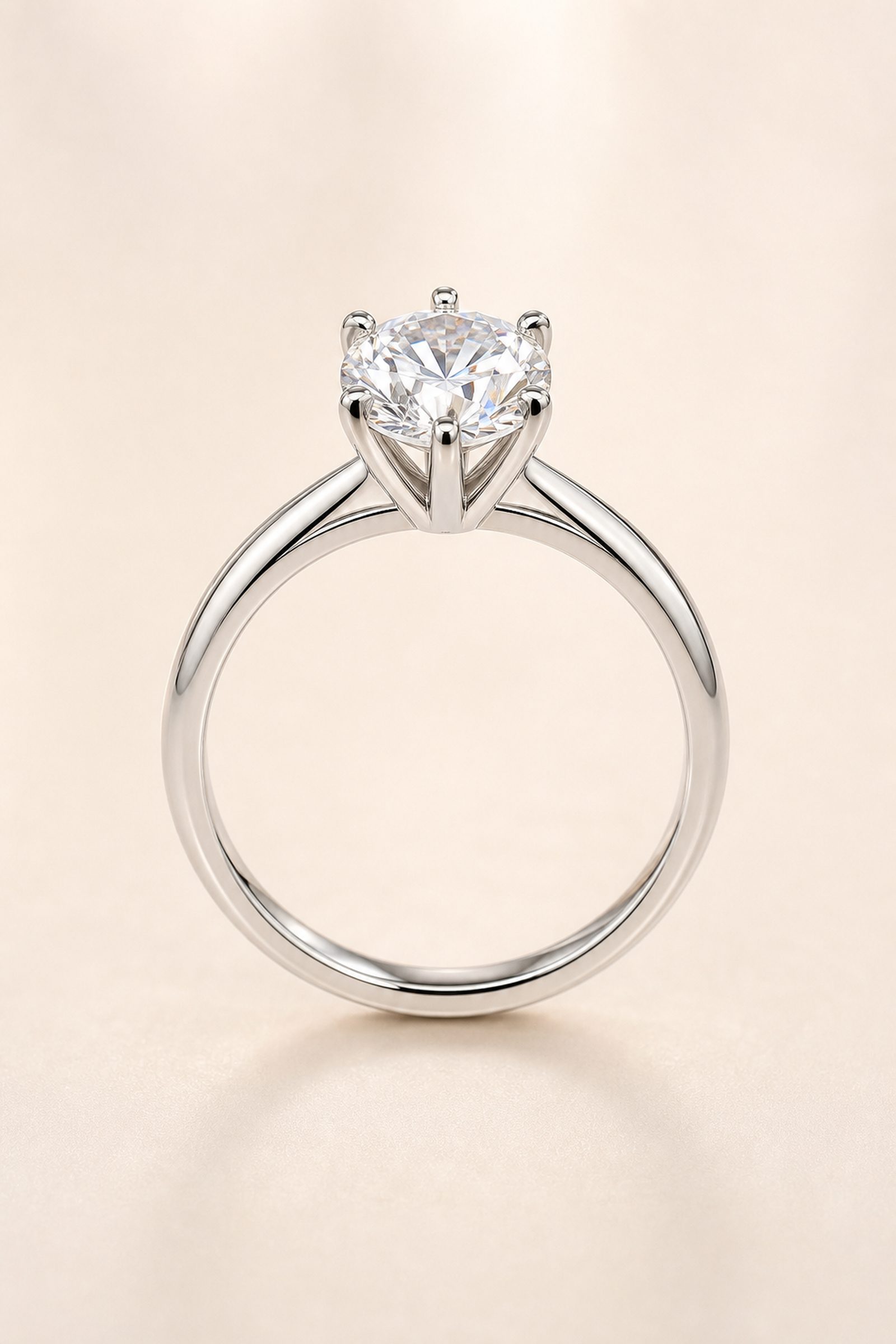
- Six-prong, six claws for a fraction more security and a rounded, balanced head, the traditional choice for a round brilliant. The extra claws hold a larger stone reassuringly.
- Bezel, a thin rim of metal wrapped around the girdle of the stone, the most protective and most modern solitaire. It guards the edges of the diamond and snags on nothing, which suits an active hand or daily wear.
- Cathedral, the centre stone lifted on graceful metal arches that sweep up from the band, adding height and presence while keeping the single-stone simplicity.
- Tension, the diamond held by the spring pressure of the band so it appears to float, the most contemporary look, engineered and finished with particular care because the metal does the holding.
A solitaire can also carry a plain, knife-edge or slightly tapered band, or a band with a hidden touch like a flush-set diamond on the inner shank, without ever becoming a different style of ring. The stone stays the star.
Solitaire works with any diamond shape
Because a solitaire is a setting style and not a diamond shape, you can set any cut on its own. A round brilliant solitaire is the timeless default, the brightest shape in the purest setting. An oval or a cushion solitaire faces up a little larger for its carat and softens the classic outline.
An emerald-cut solitaire reads architectural and calm, its long, clean facets best shown with nothing around them. A princess, pear or marquise solitaire each carries its own character, and a single-stone setting lets that character speak without competition.
The shape is the first decision, because it sets the personality of the ring; the solitaire setting then lets that shape be seen at its clearest. Compare the outlines on our guide to every diamond shape before you choose, or start from a particular cut: a round brilliant engagement ring is the most-requested place to begin.
Choosing the centre stone: the 4Cs in a single-stone ring
| Choice | What we make to order |
|---|---|
| Shape | Round, oval, cushion, emerald, princess, pear, marquise or radiant, set on its own |
| Carat | From around 0.30 ct to 5 ct and above, to your budget and hand |
| Cut | Rounds polished to GIA Excellent on our own bench; fancy shapes cut for maximum life |
| Colour | D–F colourless, or a near-colourless G–I that faces up white |
| Clarity | IF–VVS, or an eye-clean VS–SI1 where inclusions do not show |
| Metal | 18k white, yellow or rose gold, or platinum |
| Certification | GIA / EGL certified; report supplied with the stone |
Because a solitaire spends almost its entire budget on one stone, the grade of that stone is everything, there are no accent diamonds to soften a compromise. Many clients put cut and carat first and accept a near-colourless colour that faces up white and an eye-clean clarity where inclusions do not show to the naked eye.
White gold and platinum heads suit a colourless or near-colourless stone and read cool and bright; yellow or rose gold suits a warmer look and can flatter a faint tint. We talk you through the trade-offs against your budget in the brief, and quote a firm figure before any work begins. The 4Cs explained sets out the order of trade-offs in full.
How a solitaire is priced
There is no single solitaire price, because the ring is built around one diamond and a diamond’s value is set by four grades, not one. Carat is only the multiplier; cut, colour and clarity move the figure far more.
The trade prices every polished stone against the Rapaport list, an international wholesale benchmark quoted in US dollars per carat, then trades at a discount to that list for the exact make, converts it to rands at the rate of the day, and adds 15% VAT.
The per-carat price also steps up at the popular weight thresholds, 0.50 ct, 0.70 ct, 0.90 ct, 1.00 ct and above, because rough large enough to yield those weights is scarcer and the round numbers are the most sought-after, so a stone just under a threshold can be quietly excellent value.
A solitaire concentrates the budget more than any other ring, almost all of it sits in the centre stone, so where that stone is bought makes the biggest difference to what you pay. Because Prodiam cuts in-house, the importer-and-wholesaler markup is simply not in your price; you pay at a landed, Rapaport-referenced level for the same GIA-certified specification.
That is the heart of buying direct rather than from a retail jeweller. The only honest number is one quoted for your exact stone, so we show fully-landed ZAR prices on the diamond search, then quote your chosen ring firm in writing, including VAT, before any work begins.
How a solitaire is made to order
- 01
Brief
The centre-stone shape and carat, the colour and clarity range, the head style, the metal, the finger size, your budget and your deadline. We respond within 24 hours.
- 02
Choose the stone
We present GIA-certified diamonds, rounds cut to Excellent and fancy shapes cut for maximum life, on the daylight tray or by video, each with its report, and quote a firm ZAR figure.
- 03
Build & cast
The head and band are built and cast in your chosen metal, engineered around the exact stone so it sits true and secure.
- 04
Set & finish
The diamond is set into the head, the ring hand-polished to a mirror finish, and checked under loupe and microscope.
- 05
Hand-over
Presentation at Bedfordview by appointment, or insured overnight courier nationwide. Certification and a written valuation included.
Prefer a frame around the stone? Compare a halo engagement ring, which rings the centre with pavé to make it read larger, or set your solitaire in our most-requested metal with a white gold engagement ring. For the full bespoke route, the custom engagement process walks through every step. When you are ready, brief us and Darren will come back within 24 hours.
Solitaire engagement rings: common questions
What is a solitaire engagement ring?
A solitaire engagement ring is a single diamond set on its own, with no side stones, no halo and no accent diamonds, so the centre stone is the entire ring. The word solitaire describes the setting style, not the diamond shape: a round, oval, cushion, emerald, princess or any other cut can be set as a solitaire.
Because there is nothing to draw the eye away from the stone, a solitaire shows a diamond more honestly than any busier style, which is exactly why cut quality and certification matter most in this setting. Prodiam makes solitaires to order in Bedfordview, Johannesburg, with the centre diamond cut on our Bedfordview bench or sourced to order, rounds to the GIA Excellent standard.
Is a solitaire setting better than a halo for an engagement ring?
Neither is better outright, they do different jobs, so the right answer depends on what you want the ring to say. A solitaire frames a single diamond on its own, so the stone reads as exactly what it is and its cut and brilliance are on full display; it is the purest, most classic look and ages well because it never dates.
A halo rings the centre stone with a frame of small pavé diamonds, which makes a modest centre face up larger and adds extra sparkle, at the cost of the clean simplicity a solitaire keeps. A solitaire puts every rand into one stone you can see clearly; a halo spreads the look across a centre plus a frame.
We make both to order and will talk you through which suits the stone, the wearer and the budget.
Which setting is best for a solitaire engagement ring?
The most popular and most secure solitaire setting is a four- or six-prong head, which holds the diamond up into the light with the least metal covering it, so the stone shows fully and light can enter from every angle. Six prongs hold marginally more securely and suit a round brilliant; four prongs show a little more of the stone and suit fancy shapes.
A bezel setting wraps a thin rim of metal around the girdle for the most protective, modern look, ideal for an active hand, while a cathedral setting lifts the stone on graceful metal arches and a tension setting appears to suspend it between the band.
The right choice balances how the stone looks, how protected it is and the wearer’s daily life, and we build each one to order on our own Bedfordview bench.
Why does diamond cut matter most in a solitaire setting?
In a solitaire there is nothing to hide behind, no halo, no side stones and no pavé to add borrowed sparkle, so the diamond stands alone and its own cut decides how alive the ring looks.
Cut is the grade that governs brilliance and fire, how much light the stone returns to the eye, and a poorly cut diamond leaks light and looks flat no matter how good its colour or clarity. Because a solitaire exposes the stone completely, it rewards a precisely cut diamond more than any other setting.
Prodiam polishes its centre stones to GIA Excellent cut grade in-house on our Bedfordview bench, so the part of the ring that carries it is the part we control, and every stone comes with its GIA report so you can verify the grade before you commit.
How much does a solitaire engagement ring cost in South Africa?
There is no single price, because a solitaire is built around its one diamond, and the diamond’s four grades, carat, cut, colour and clarity, set most of the cost, with the metal and the setting on top.
The trade prices every stone against the Rapaport list, an international wholesale benchmark in US dollars per carat, then trades at a discount to that list and converts it to rands at the day’s rate, with 15% VAT added. Because a solitaire spends almost its whole budget on the centre stone rather than on accent diamonds, the grade of that one stone matters more here than in any other ring.
Prodiam buys rough and cuts it in-house on our Bedfordview bench, so you pay a landed stone price plus honest manufacturing rather than a retail markup. You receive a firm ZAR quote, VAT inclusive, before any work begins, and you can see fully-landed ZAR prices on real GIA-certified stones on our diamond search.
Can I have a solitaire engagement ring made if I am not in Johannesburg?
Yes, clients commission solitaire rings across South Africa, as well as from South Africans abroad. The stone and design conversation happens by video and WhatsApp, you choose the centre diamond from its GIA report plus loupe photography and a live video viewing, and you approve the setting before anything is made.
The finished ring is delivered insured and overnight nationwide via Brink’s or G4S, with its certification included, and a written insurance valuation on request. If you are keeping the proposal a surprise and are unsure of the finger size, we size it from a ring she already wears, so the surprise stays a surprise.
Last reviewed: June 2026.