
Natural Diamonds · South Africa · Cut In-House
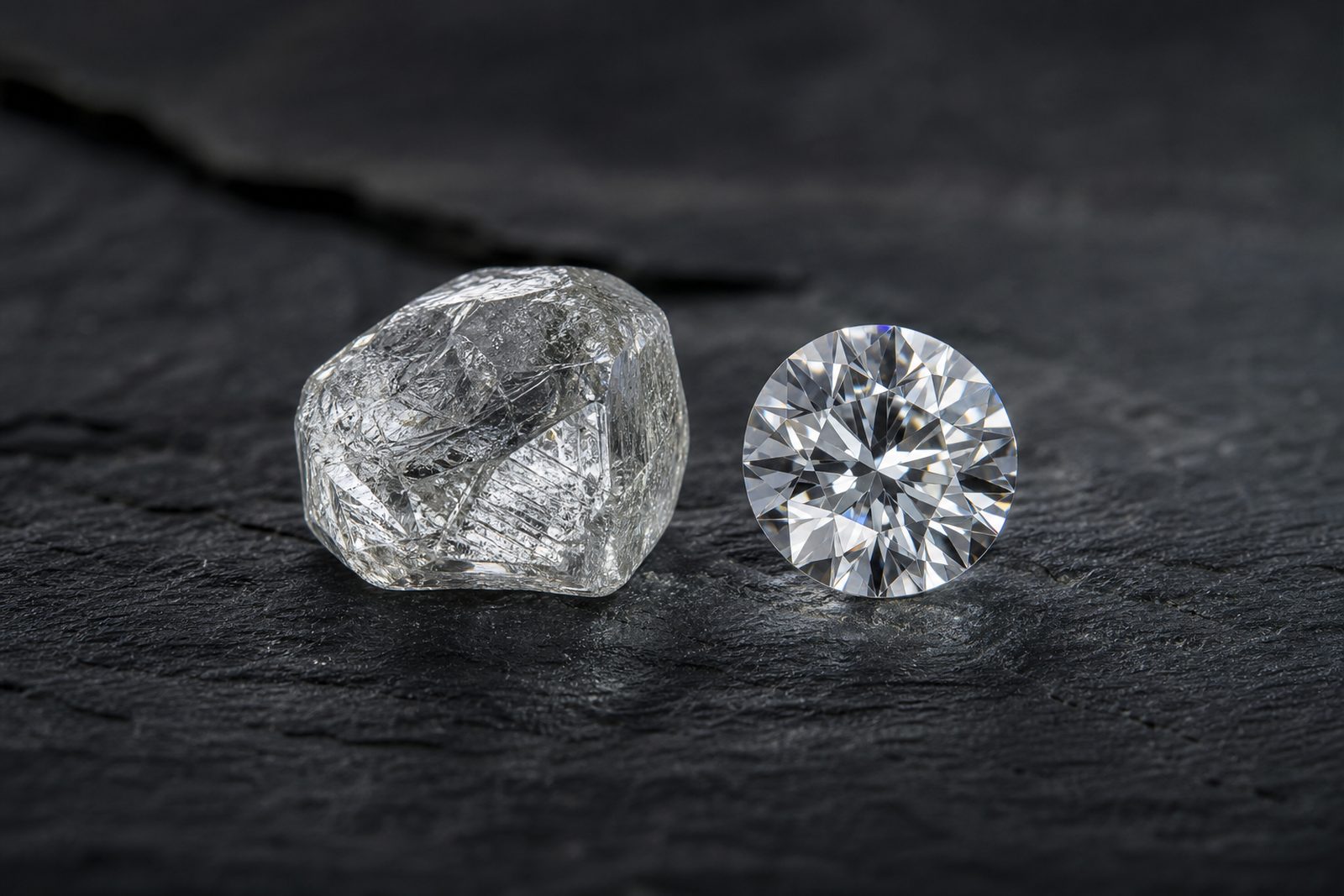
Natural diamonds in South Africa, cut from rough by a local cutting house.
Buy natural diamonds in South Africa through Prodiam in Bedfordview, Johannesburg. Compare loose stones by shape, carat, colour, clarity and laboratory report, with a choice of held inventory for a viewing or diamonds sourced to your specification.
Kimberley-Process documented, GIA-certified, and traceable from rough to your finger.
See fully-landed ZAR prices on natural stones Talk to Darren →
-
Natural diamonds only
We sell natural diamonds and diamond-set jewellery. Ask us about the grading report and available origin documentation for your chosen stone. Why we don’t sell lab-grown →
-
Independent grading reports
The grading laboratory is shown per stone. Review its report and the individual diamond before choosing; sourced examples can include GIA, EGL and IGI.
-
Insured delivery, SA & worldwide
Overnight across South Africa via Brink’s, G4S or our nominated jewellery courier. Insured worldwide dispatch via Ferrari Group and FedEx Custom Critical.
-
14-day in-person exchange
In-person sales at the viewing room come with a 14-day exchange courtesy on stock pieces. Distance-sale CPA cooling-off applies.
What a natural diamond actually is
A natural diamond is a single crystal of carbon that formed deep in the earth’s mantle, roughly 150 kilometres down, under extreme heat and pressure, over a span of one to three billion years. Ancient volcanic eruptions then carried that carbon toward the surface inside the kimberlite rock it is mined from today. Nothing about that process can be hurried, and the earth made a fixed amount of it.
That is the whole of what the word natural means here: mined, not manufactured, and finite.
It helps to be precise about what natural is being distinguished from. A lab-grown diamond is the same material, real diamond, pure crystallised carbon, but grown in a chamber in a few weeks by CVD or HPHT and producible without limit. A simulant such as cubic zirconia or moissanite is not diamond at all, just a stone that resembles one.
Prodiam deals exclusively in the first category, and the full natural-versus-lab-grown comparison sets out, row by row, why that distinction drives price and value rather than appearance.
Where South African diamonds come from
South Africa is one of the founding nations of the modern diamond trade. The Kimberley discoveries of the 1870s gave the world its first great diamond rush and, with it, the open mine that became known as the Big Hole.
The country still produces natural rough today, from kimberlite pipes and alluvial deposits across the Northern Cape, North West and the Free State, and Johannesburg remains the commercial centre where that rough is bought and sold.
Most of the rough Prodiam cuts is bought at De Beers Consolidated Mines (DBCM) viewings in Johannesburg, under the Emerging Beneficiation Customer programme, with the balance from South African tender houses and from independent diggers we have known for years. Every parcel enters our hands through Kimberley-Process-compliant channels, the international scheme, in force since 2003, that keeps conflict diamonds out of the legitimate trade.
How that conflict-free assurance and the chain of custody work in detail is set out on the ethical, traceable sourcing page and in our Kimberley Process explainer.
A recognised De Beers Emerging Beneficiation Customer
Beneficiation is South African policy with a simple aim: keep more of the rough being cut and polished inside the country, where the value and the skilled work stay, rather than shipping it abroad whole. The De Beers Emerging Beneficiation Customer programme is one route by which that happens, a contracted, audited channel through which recognised local manufacturers buy rough directly.
Prodiam’s cutting entity is a recognised Emerging Beneficiation Customer, which is precisely how rough reaches our own bench rather than being bought in already polished from a wholesaler.
That matters for two reasons beyond the paperwork. It means the stones you buy were cut in South Africa, by South Africans, from rough bought at source, and it means there is no anonymous middleman whose sourcing you cannot see. The guide to SA diamond cutting and beneficiation explains where this sits in the wider trade, and the look inside Procut DCW shows the bench where the rough becomes a polished diamond.
Why Prodiam is natural-only, and what it means for value
We are not neutral, and it would be dishonest to pretend otherwise. Prodiam works in natural diamonds only. We made that choice deliberately, and it rests on two things. The first is value retention. The entire case for a diamond holding any of its worth rests on finite supply, and only a natural stone has it.
Because the earth made a fixed amount, a natural diamond holds a market-clearing floor and can be traded in against its original GIA report; a lab-grown stone, made on demand, has fallen sharply in price as production scaled and has effectively no resale or trade-in market.
It is more honest to call a natural diamond a store of value than an investment, neither is a growth asset, but the gap in retained value between the two is real. The store-of-value briefing sets out what finite supply does and does not do.
The second reason is provenance. A South-African-cut natural diamond carries a documented origin we can stand behind, from De Beers rough through our own bench to the finished piece, and a reactor cannot replicate that. None of this is a knock on lab-grown as a category, it is a genuinely reasonable choice for a buyer who wants maximum visible carat and is not optimising for resale.
It is simply not what we make, and we would rather tell you that plainly, and compare the two honestly, than sell you something we do not believe suits your brief.
How a natural diamond is graded and certified
Every natural diamond is graded on the 4Cs, carat (its weight), colour (how near-colourless it is, on the D-to-Z scale), clarity (the size and visibility of its inclusions) and cut (how well its facets return light).
Cut is the one a cutter controls directly, and it is why our round brilliants are polished to the GIA Excellent cut standard, on our own bench where we cut the stone: a well-cut stone simply gives back more light than a poorly-cut one of identical weight and colour.
Grading is done independently, never by us. Each stone is certified by the GIA or EGL, with GIA the primary laboratory, and you receive the full report when you reserve the stone. A natural stone receives a standard “Diamond Grading Report” with no growth-method field, where a lab-grown stone would receive a “Laboratory-Grown Diamond Report”.
You can verify any report number yourself against the GIA report-check service, and because GIA South Africa is in our building, a stone can be re-checked on the spot before you settle.
The cutting house behind the stone
The reason Prodiam can speak to provenance and price the way it does is that one operation holds the stone from rough to finished piece. We are a diamond dealer and cutting house, directed by Darren Etkind from a single Bedfordview address, not a retail shopfront. We buy rough, cut and polish it ourselves at Procut DCW, and sell the polished output direct; when a stone is better bought in polished, we buy it at trade terms and tell you so.
A retail jeweller only enters the chain once the cutting is already done.
Holding that chain ourselves is what lets us price at a landed rand level rather than at a retail counter. We do not publish a rand figure on a page, because no honest one exists in the abstract: a natural diamond is priced on its own 4Cs, read against the Rapaport wholesale list, then converted at the day’s dollar-to-rand rate, with 15% VAT on top for a local sale.
The per-carat price rises steeply with size, and round weights, the half-carat, the full carat, the two-carat, carry a “magic-number” premium over a stone a few points lighter. We explain how that build-up works on the diamond price page, and the live diamond search shows fully-landed ZAR prices on the actual stones; or we will quote you firm, including VAT, before any commitment.
Choose a natural diamond, by stone or by knowledge
Whether you are starting from the stone, from a piece you want made, or simply from the questions, the natural-diamond routes below set out what to read and where to buy. Each links through to its own page.
- SA diamond cutting & beneficiation How rough mined in South Africa is cut and polished inside the country rather than exported whole, and where Prodiam’s De Beers Emerging Beneficiation Customer status sits in that chain.
- The 4Cs of diamond grading Carat, colour, clarity and cut explained from the cutter’s bench, the four measures every natural diamond is graded on and how they set its price.
- GIA-certified natural diamonds Independently graded natural stones on the bench, each with its GIA report you can verify yourself before you commit.
- Loose natural diamonds Certified loose stones ready to buy on their own or to set into any piece, cut in-house to GIA Excellent cut grade.
- Ethical & traceable sourcing The Kimberley Process, conflict-free assurance, and how short the chain gets when the rough is ours and the bench is ours.
- Natural vs lab-grown, compared The honest difference, row by row, on value retention, price trajectory and certification, and exactly why Prodiam chose natural.
- Diamonds as a store of value What finite supply does, and does not, do for a natural diamond’s resale floor, and why “store of value” is the honest framing.
- Verify a diamond How to confirm any stone is the natural, certified diamond its paperwork claims, including same-address GIA re-checking in Bedfordview.
If you are buying for the first time, the first-time diamond buyer’s guide walks the whole process through, and the buying direct versus a retail jeweller comparison explains what changes when you buy from the cutting house. To understand the stone itself before you choose, the carat guide and the diamond shapes guide are the place to start; remote buyers can read how a diamond purchase works at a distance in South Africa.
Natural diamonds in South Africa: common questions
What is a natural diamond?
A natural diamond is pure carbon that crystallised deep in the earth’s mantle over roughly one to three billion years, under extreme heat and pressure, and was carried toward the surface by ancient volcanic activity. It is mined, not made.
That distinguishes it from a lab-grown diamond, which is the same material grown in a reactor in a few weeks, and from simulants like cubic zirconia or moissanite, which are not diamond at all. Prodiam works in natural diamonds only: we buy natural rough at De Beers DBCM viewings and South African tender houses and cut it in-house at Procut DCW in Bedfordview.
Where do South African diamonds come from?
South Africa has been a primary diamond source since the Kimberley discoveries of the 1870s, and the country still produces natural rough from kimberlite pipes and alluvial deposits across the Northern Cape, North West and Free State.
Most of the rough Prodiam cuts is bought at De Beers Consolidated Mines (DBCM) viewings in Johannesburg under the Emerging Beneficiation Customer programme, with the balance from South African tender houses and independent diggers we have worked with for years. Every parcel moves through Kimberley-Process-compliant channels. Cutting that rough inside the country, rather than exporting it whole, is what beneficiation means, and it is the trade Prodiam is in.
Are natural diamonds worth it?
For a piece you intend to keep or pass on, yes, and the reason is finite supply. A natural diamond will not appreciate like a rare watch, so it is better described as a store of value than an investment, but because the earth made a fixed amount of it, it holds a market-clearing floor and can be traded in against its GIA report.
A lab-grown stone, made on demand, has fallen heavily in price as production scaled and has effectively no resale or trade-in market. Buying cutter-direct removes the retail markup as well, so more of what you pay sits in the stone itself. If the purchase is a fashion piece where visible size is the only point, value retention may simply not be the question.
What is the difference between a natural and a lab-grown diamond?
Chemically and optically there is none: both are crystallised carbon, and a lab-grown stone is a real diamond, not an imitation. The difference is origin and economics. A natural diamond formed in the earth over a billion years and exists in finite supply; a lab-grown diamond is manufactured in weeks by CVD or HPHT and can be produced without limit. That single fact drives price, price trajectory and value retention.
The certificate differs too: a lab-grown stone receives a GIA “Laboratory-Grown Diamond Report” that names the growth method, and stones above 0.50ct are laser-inscribed “LG” on the girdle, while a natural stone receives a standard grading report. Prodiam supplies natural only and will compare the two honestly with you.
How do I know a natural diamond is certified and genuine?
Insist on an independent laboratory report and verify it yourself. Every Prodiam stone is graded by the GIA or EGL, with GIA the primary laboratory, and you receive the full report when you reserve the stone. You can check any GIA report number against the GIA report-check service before you settle, and because GIA South Africa is in our building, a stone can be re-checked on the spot.
The report records the 4Cs, carat, colour, clarity and cut, and confirms the stone is natural; we never issue our own grade in place of a laboratory report.
Does Prodiam sell lab-grown diamonds?
No. Prodiam works in natural, mined-Earth diamonds only, by conviction rather than price. We do not stock, sell or quietly substitute synthetic stones. We will give you straight, non-preachy guidance on lab-grown as a category, because for a buyer optimising purely for visible carat it can be a reasonable choice, but it is not what we make.
Our case for natural rests on two things the comparison bears out: the finite-supply value floor, and a documented South African chain of custody from rough to finished ring.
Last reviewed: June 2026.