
The Buyer’s Guide · From a Bedfordview Cutting House
How to buy a diamond in South Africa, from the people who cut them.
When you buy a diamond in South Africa, three things decide whether you buy well: the cut, the certificate, and who you buy from. Get those right and it stops being a leap of faith.
This is the short version of what we tell clients at the bench: judge cut first, because it is the only one of the 4Cs made by human hands and the one that decides whether a stone sparkles; insist on an independent GIA report and verify it yourself; and understand the markup layers between the mine and the retail counter, so you know why buying direct from a cutting house is the keenest honest price.
Prodiam buys rough, cuts stones on its own bench and also sources to order in Bedfordview, Johannesburg, and sells direct, natural diamonds only, GIA-certified, priced on application.
Get a fully-landed ZAR price to your spec Send us a spec instead → Email Darren directly →
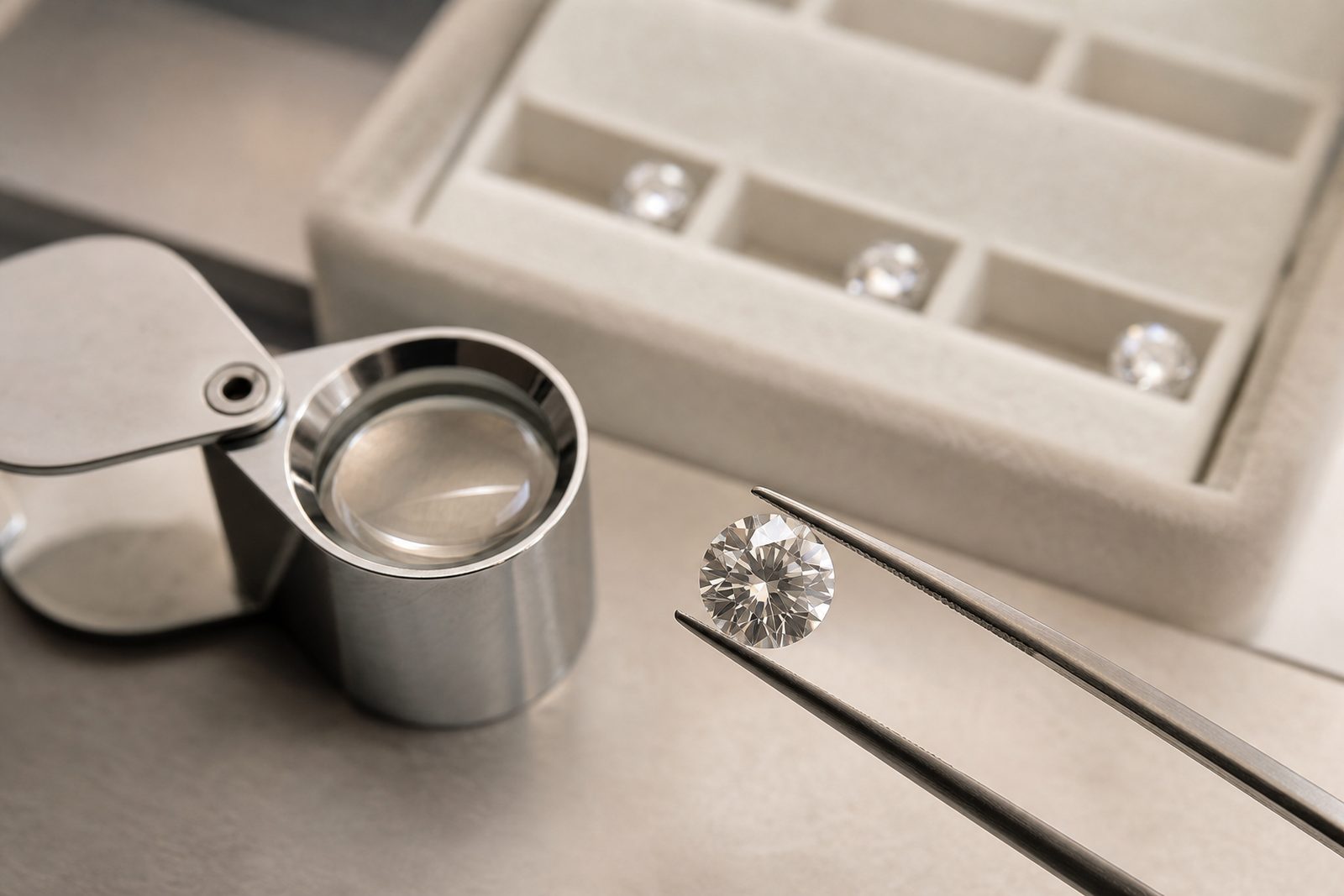
1. The 4Cs, and which one matters most
Every diamond is graded on four things, the “4Cs”: cut, colour, clarity and carat. They are not equal. Three of them, colour, clarity and carat, are fixed by nature when the diamond forms. Only cut is created by a person, at the bench, and it is cut that governs how light enters the stone, bounces around inside it and returns to your eye as brightness, fire and sparkle.
A beautifully-cut diamond a grade lower in colour will out-sparkle a carelessly-cut stone that grades higher on paper. So the order of priority for a first-time buyer is straightforward:
- Cut, first, always. Set it to GIA Excellent cut grade and do not compromise here. It is the difference between a diamond that looks alive and one that looks like glass.
- Carat, size, set against budget. Price rises steeply at the round numbers (1.00ct, 2.00ct), so a stone just under a landmark weight can look almost identical for noticeably less.
- Colour, near-colourless is the sweet spot. The G–J band reads white face-up in a ring; paying for D–F colourless is a preference, not a necessity, unless the setting is platinum or white gold and you want absolute whiteness.
- Clarity, aim for eye-clean. A VS stone, or a well-placed SI, has inclusions you cannot see without magnification. Pay for the grade your eye can read, not the one only a loupe can.
The single most useful rule we can give you: spend on cut, save on the grades the unaided eye cannot see. The full mechanics are in our guide to the 4Cs of diamond grading.
2. Certification, insist on GIA, then verify it yourself
A diamond is only worth what its grading says it is, and grading is only worth anything if it is independent. Insist on a GIA report. The Gemological Institute of America grades to the most consistent and most respected standard in the world, and crucially it has no interest in selling you the stone.
Other laboratories, EGL is the one you will meet most often in South Africa, grade more loosely, so the same diamond can be described a grade or two better than GIA would call it, which quietly inflates the price.
Two habits protect you. First, read the report against the diamond in front of you, the report number is laser-inscribed on the girdle of most GIA stones, and the plotted inclusions on the report should match what you see under the loupe.
Second, verify the report number yourself on GIA’s free Report Check service before you pay a cent; it takes thirty seconds and confirms the report is real and unaltered. Treat a vague “certified” with no laboratory named, or an in-house “valuation certificate” standing in for an independent report, as a warning rather than a reassurance.
Our walk-through of how to read a GIA report shows you exactly what each line means, and you can see our GIA-certified diamonds graded to that standard.
3. Where to buy, and the markup you are really paying
The same GIA-certified diamond can cost meaningfully different amounts depending on how many hands it passes through before it reaches you. There are three broad routes:
| Where you buy | What sits in the price |
|---|---|
| Retail / mall jeweller | Buys the polished stone in from a wholesaler, then adds counter margin, showroom rent, stock-holding cost and staff. Several markups stacked before you. |
| Online-only store | Lists stones it does not own from a shared global feed; thinner overhead than a shop, but it cannot speak to the actual cut, outsources imaging, and you still pay a listing margin. |
| Cutting house, direct | Buys rough, cuts and polishes the stone in-house, sells it to you with no middle layers. You pay a landed, Rapaport-referenced price and you can talk to the people who cut it. |
Each link in the chain, cutter, wholesaler, retailer, adds its margin and its costs. Buying cutter-direct removes the retail markup entirely: a near-colourless, eye-clean one-carat round, the most-requested specification in South Africa, costs structurally less from the cutting house that polished it than across a showroom counter, for an identically-graded stone.
That is the whole logic of Prodiam’s single-custody “rough-to-ring” model, and it is why we can quote a keen, firm price. The full explanation is in wholesale vs retail diamond pricing; when you want to compare real numbers, our live diamond search shows fully-landed ZAR prices, and you can read more about buying from a diamond dealer in South Africa.
Pricing on a diamond is always quoted firm before any work begins; we publish no fixed figure here because the price is built from the exact 4Cs of the exact stone you choose. What we can promise is the basis, landed, Rapaport-referenced, with the retail layer removed.
4. The five biggest diamond-buying mistakes
Almost every regret we hear about comes down to one of these:
- 01
Overpaying at retail
Paying a full showroom markup for a stone you could have bought cutter-direct. The grades are identical; the price is not.
- 02
Ignoring cut
Chasing carat weight or a top colour grade while accepting a mediocre cut, so the diamond looks dull. Cut is what makes a diamond sparkle; treat it as non-negotiable.
- 03
Trusting an unverified certificate
Accepting “certified” at face value, or a loosely-graded report, without verifying the report number independently. Always check it on GIA’s Report Check yourself.
- 04
Buying a fancy shape with a bow-tie
Ovals, marquises, pears and cushions can carry a “bow-tie”, a dark band across the centre left by poor cutting. Tilt the stone, or check the video, and walk away from a heavy one.
- 05
Paying for what the eye cannot see
Buying flawless clarity or top colour when an eye-clean, near-colourless stone looks the same in a ring. Spend that budget on cut or carat instead.
5. Buying remotely, safely, with insured delivery
You do not need to live in Johannesburg to buy well. Most of our clients across South Africa buy without ever standing at a counter, and it is safe when three conditions hold. The diamond carries an independent GIA report you verify yourself before paying.
You see the actual stone before you commit, a video call, HD photography and 360-degree footage of that specific diamond, never a stock image. And it arrives fully insured: we ship nationwide by insured Brink’s or G4S courier, with a written valuation for your own cover.
With a verified report, a live view of the real stone and insured transit, remote buying is at least as safe as a showroom, often safer, because you hold the report before you decide.
When you are ready, the fastest route is our live diamond search, where you set your spec and see fully-landed ZAR prices on GIA-certified stones; browse our loose diamonds; or have a stone set into a bespoke engagement ring on our own bench. If you would rather just describe what you want, send Darren the spec and we come back within 24 hours with options and a firm price.
Start with the shape, then the stone
Many buyers begin with a shape in mind. Each behaves differently, a round brilliant returns the most light and hides inclusions best, while fancy shapes like the oval or emerald cut trade some sparkle for a larger face-up look and their own character. Read the shape pages to narrow it down, then set your spec on the live search and let cut, your budget and a verified GIA report do the rest.
Buying a diamond in South Africa: common questions
What should I look for first when buying a diamond?
Cut, before anything else. Cut is the only one of the 4Cs that is made by human hands rather than by nature, and it governs how much a diamond actually sparkles, a well-cut, lower-colour stone outshines a poorly-cut, higher-colour one every time.
Set cut to GIA Excellent grade and judge it first; then choose a carat weight that fits your budget, a colour in the near-colourless band (G–J shows white in a ring), and an eye-clean clarity such as VS or a well-placed SI. Spend on cut, save on the grades the eye cannot see unaided.
Which diamond certificate should I trust?
Insist on GIA. The Gemological Institute of America is the independent laboratory whose grading is the most consistent and the most respected worldwide, and it has no stake in selling you the stone. Other reports, EGL among them, grade more loosely, so a stone may be described a grade or two better than a GIA report would call it.
Always read the report against the diamond in front of you, and verify the report number yourself on GIA’s free Report Check service before you pay. A loose claim of “certified” with no laboratory named, or an in-house “valuation” in place of an independent report, is a flag, not a credential.
Where is it cheapest to buy a diamond in South Africa?
Direct from a cutting house, because you skip the markup layers that sit between the polished stone and a retail counter. A mall jeweller typically buys a stone in from a wholesaler, who bought it from a cutter, who bought the rough, and each link adds its margin and its overheads before the price reaches you.
A South African dealer who buys rough, cuts stones on its own bench and also sources to order and sells direct removes those middle layers, so you pay a landed, Rapaport-referenced price for the same GIA-certified stone. “Cheapest” is never the right test on its own, the right test is the most stone, correctly graded, for your money, but cutter-direct is structurally the keenest honest price.
What are the biggest diamond-buying mistakes?
Five recur.
Overpaying at a retail counter for a stone you could buy direct; ignoring cut and chasing carat or colour, so the diamond looks dull; trusting an unverified or loosely-graded certificate instead of an independently-verified GIA report; buying a fancy shape, oval, marquise, pear, cushion, without checking it for a bow-tie (a dark band across the centre that poor cutting leaves behind); and paying for clarity or colour grades the naked eye cannot tell apart.
The common thread is buying on the headline number rather than on what the stone actually is. Read the report, see the stone, and buy the cut first.
Can I buy a diamond safely without seeing it in person?
Yes, most of our clients outside Johannesburg do exactly that, and it is safe when three things are true. First, the diamond carries an independent GIA report you can verify yourself before you pay. Second, you see the actual stone before you commit, by video call, with HD photography and 360-degree footage of that specific diamond, not a stock image.
Third, it arrives fully insured: Prodiam ships nationwide by insured Brink’s or G4S courier with a written valuation for your own cover. Buy on a verified report, a live view of the real stone, and insured delivery, and remote buying is as safe as standing at a counter, often safer, because you have the report in hand first.
-
Natural diamonds only
We sell natural diamonds and diamond-set jewellery. Ask us about the grading report and available origin documentation for your chosen stone. Why we don’t sell lab-grown →
-
Independent grading reports
The grading laboratory is shown per stone. Review its report and the individual diamond before choosing; sourced examples can include GIA, EGL and IGI.
-
Insured delivery, SA & worldwide
Overnight across South Africa via Brink’s, G4S or our nominated jewellery courier. Insured worldwide dispatch via Ferrari Group and FedEx Custom Critical.
-
14-day in-person exchange
In-person sales at the viewing room come with a 14-day exchange courtesy on stock pieces. Distance-sale CPA cooling-off applies.