
Cushion Cut Engagement Rings · Bedfordview, Johannesburg
Cushion cut diamond engagement rings, made to order in South Africa.
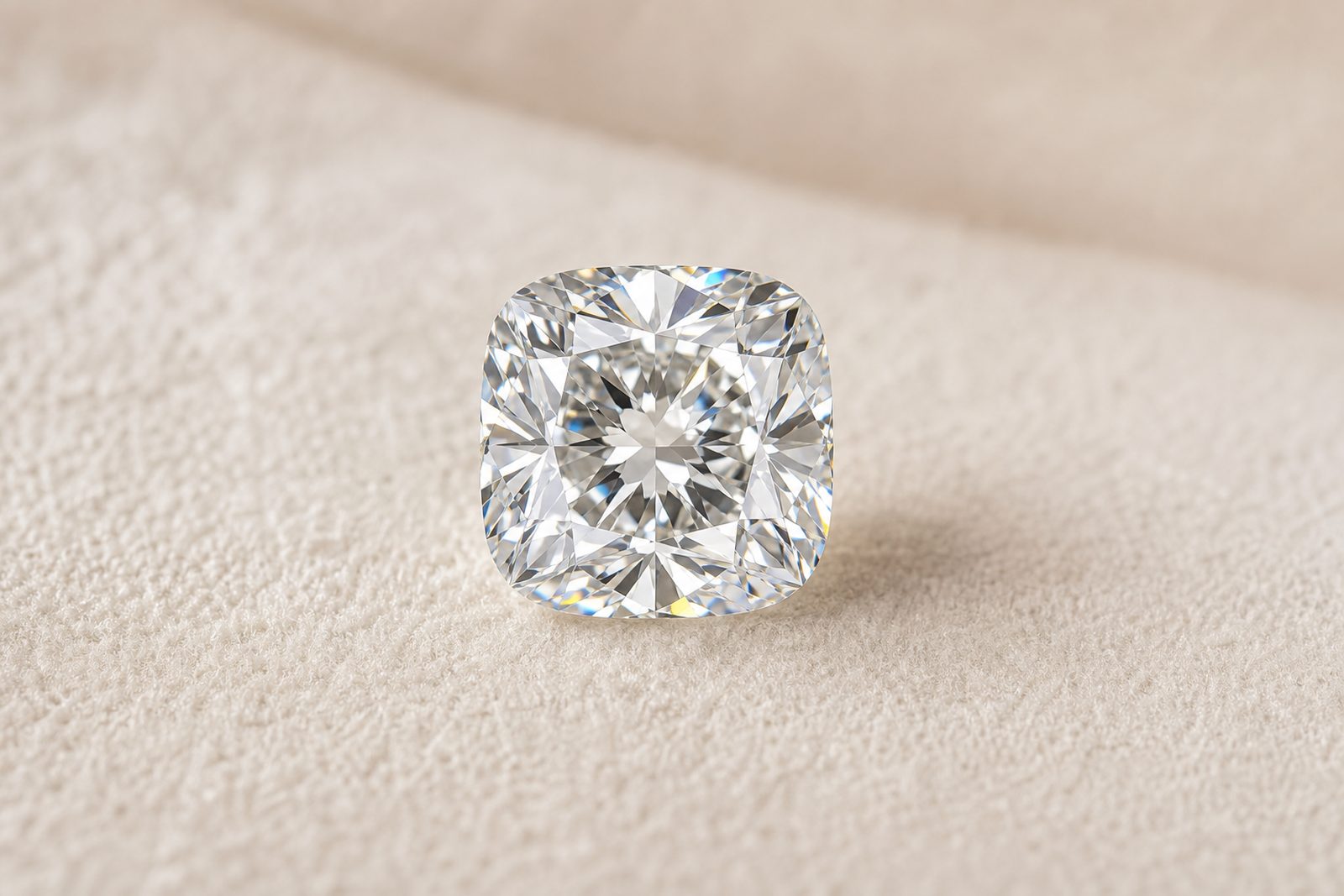
Cushion-cut diamond engagement rings combine a soft, rounded outline with a choice of square or elongated proportions. Commission yours in Bedfordview with a natural diamond, your preferred facet style and a setting chosen for your budget.
Every Prodiam cushion ring is made to order in our Bedfordview workshop, the centre stone cut on our own bench or sourced for you in the facet style you prefer and chosen face-up for colour. Natural, GIA-certified diamonds, priced on application, with insured delivery anywhere in South Africa.
Brief us on a cushion ring Explore ring designs → Custom engagement rings →
-
Natural diamonds only
We sell natural diamonds and diamond-set jewellery. Ask us about the grading report and available origin documentation for your chosen stone. Why we don’t sell lab-grown →
-
Independent grading reports
The grading laboratory is shown per stone. Review its report and the individual diamond before choosing; sourced examples can include GIA, EGL and IGI.
-
Insured delivery, SA & worldwide
Overnight across South Africa via Brink’s, G4S or our nominated jewellery courier. Insured worldwide dispatch via Ferrari Group and FedEx Custom Critical.
-
14-day in-person exchange
In-person sales at the viewing room come with a 14-day exchange courtesy on stock pieces. Distance-sale CPA cooling-off applies.
Diamond price guidance, captured 8 September 2026. These figures describe samples of sourced listings, with VAT and delivery for the stones included. They are not current stock guarantees. Settings and making are additional where jewellery is discussed; confirm the complete written quote.
What acushion engagement ring costs
A 0.95–1.09 ct cushion centre at H colour and SI1 clarity or better had a guide price of R46 400 in the lower-priced listings sampled on 8 September 2026. The diamond is only part of the ring: metal, setting, any side diamonds and making are quoted with it. This figure is not a finished-ring price.
The guide uses the median of up to 40 lower-priced returned listings. It does not represent every cushion diamond or every ring design. Compare diamond prices by weight and ask for a quote for your shape, setting and total budget.
Ask about acushionCheck one-carat cushion diamonds →
No two diamonds are the same
A table describes a market, not a stone. Two diamonds identical on paper can differ by a third in price and both figures be right: how well the stone is actually cut and how much light it returns, where the inclusions sit and whether the eye finds them, how strongly it fluoresces, and how keenly that one happens to be priced against the international trade benchmark on the day. We check every stone against that benchmark before we show it to anybody, and the number that matters is the one quoted in writing on the stone you actually choose.
Ask us what your budget buysSearch the live inventory →
Captured 8 September 2026; guide figures rounded up to the next R100. Colour and clarity tables use sampled medians and percentile bands; rows without a measured range may use a limited lower-priced sample. Prices and availability can change. Your written quote identifies the actual stone and all inclusions.
The cushion cut: a pillow of soft, antique fire
The cushion takes its name from its shape: a square or slightly rectangular outline with rounded corners and gently curved sides, like a small pillow or cushion. It is a brilliant cut, sharing the light-scattering family of facets with the round, the oval and the princess, but it descends from the old-mine cut of the eighteenth and nineteenth centuries, cut by candlelight long before electric light and modern proportioning.
That heritage shows in how it behaves: instead of the round’s precise, restless glitter, a cushion returns a warmer, broader, more rolling fire. It is the shape for a buyer who wants romance and vintage softness rather than maximum, clinical sparkle, and it sits beautifully in both classic and contemporary settings.
Chunky or crushed ice: the two facet styles
More than almost any other shape, the cushion comes in two distinct facet styles, and choosing between them matters more than any single grade because it changes the entire look of the stone.
- Chunky, or “old mine” style, has larger, broader facets that return light in big, distinct flashes. It reads as more structured, more vintage and more romantic, with visible architecture inside the stone, the look closest to the antique cushions of the 1800s.
- Crushed ice has smaller, more numerous facets that scatter light into a fine, shimmering, sparkling texture, like sunlight on broken ice. It hides inclusions a little better and reads as busier and more glittery, with less obvious internal structure.
Neither style is graded higher by GIA, and neither is “better”; it is purely a matter of taste. Because we cut and select our own stones at Procut DCW, we show you both styles face-up under daylight so you can decide with your own eyes which fire you prefer before any stone is set.
Why colour matters more in a cushion
A cushion’s warm, broad way of holding light is its charm, but it also means the stone can show a touch more body colour than a round of the same grade, where the harder, faster sparkle tends to mask tint.
So a cushion rewards spending a little more on colour: we generally steer clients toward a D to G grade, and a little stronger again when the ring is in white gold or platinum, where any warmth reads more readily against the cool metal. In yellow or rose gold a slightly warmer stone can sit very happily, because the metal carries the warmth with it.
Clarity is more forgiving, the busy brilliant faceting hides inclusions well, so an eye-clean VS to SI1 stone usually faces up perfectly clean. Setting the right spec for the shape, the metal and the wearer, rather than to a fixed rule, is precisely where buying from the cutter pays off.
Settings that suit a cushion
- Halo, a pavé frame around the centre stone, is the signature cushion setting: it amplifies the soft outline, adds light and makes the stone read larger, and a cushion’s rounded corners sit comfortably inside the frame.
- Solitaire, the cushion alone in a four-claw head, shows off the pillowy shape and the facet style cleanly, usually with claws set at the rounded corners.
- Three-stone, the cushion flanked by two side stones, round, half-moon or trapezoid, a classic, balanced look with extra presence.
- Pavé shoulders, small diamonds set down the band to carry light toward the centre, in any of the above.
A cushion’s rounded corners are inherently less vulnerable than the sharp points of a princess or pear, so it is a forgiving everyday shape, but we still talk you through claw profile and protection against how the ring will be worn.
Choosing a cushion cut
| Choice | What we make to order |
|---|---|
| Facet style | Chunky / old-mine for structured vintage fire, or crushed-ice for fine shimmer |
| Length-to-width | ~1.00–1.05 for a square cushion, ~1.10–1.30 for a rectangular cushion |
| Carat | From around 0.50 ct to 5 ct and above, to your budget and hand |
| Colour | D–G recommended; the cushion shows a touch of warmth, more so in white metal |
| Clarity | An eye-clean VS–SI1, chosen so inclusions do not show at the table |
| Metal | 18k white, yellow or rose gold, or platinum |
| Certification | GIA / EGL certified; report supplied with the stone |
Pricing is on application, the stone drives the figure, and you receive a firm ZAR quote, VAT inclusive, before any work begins. For firm, fully landed figures on a specific carat and grade, the source-a-diamond service returns the real number.
How a cushion cut ring is made to order
- 01
Brief
Facet style, ratio, carat, colour and clarity range, setting style, metal, budget and deadline. We respond within 24 hours.
- 02
Choose the stone
We present GIA-certified cushions in both facet styles, face-up on the daylight tray or by video, each with its report.
- 03
Build & cast
The setting is built and cast in your chosen metal, with any halo or pavé matched to the centre at the bench.
- 04
Set & finish
The cushion is set with its rounded corners protected, the ring hand-polished, and checked under loupe and microscope.
- 05
Hand-over
Presentation at Bedfordview by appointment, or insured overnight courier nationwide. Certification and a written valuation included.
Comparing shapes? See the round brilliant, oval, radiant and emerald cuts, or weigh them all in our guide to every diamond shape. A halo is the cushion’s natural partner, so the halo engagement ring page is worth a look too. When you are ready, brief us and Darren will come back within 24 hours.
Cushion cut engagement rings: common questions
What is a cushion cut diamond?
A cushion cut is a brilliant-faceted diamond with a soft, pillow-like outline: a square or gently rectangular shape with rounded corners and rounded sides, which is where the name comes from. It is one of the oldest shapes still cut today, descended from the old-mine cut of the 1800s, and it returns light as a warm, broad fire rather than the precise, restless sparkle of a modern round brilliant.
That softer, slightly antique character is exactly why many buyers choose it.
What is the difference between a chunky and a crushed-ice cushion?
It is the facet style, and it changes the whole look of the stone. A chunky or "old mine" style cushion has larger, broader facets that return light in big, distinct flashes, a more vintage, romantic look with visible structure. A crushed-ice cushion has smaller, more numerous facets that scatter light into a fine, sparkling, almost shimmering texture, like sunlight on broken ice.
Neither is graded better by GIA; it is purely a matter of taste, so we show you both styles face-up so you can see which you prefer before we cut or set the stone.
How does a cushion cut compare to a round diamond?
A round brilliant gives the most sparkle of any shape and is the only shape GIA assigns an overall cut grade to, so it is the easiest stone to buy with confidence. A cushion trades a little of that crisp brilliance for a softer, warmer fire and a gentler, more antique outline, and it tends to face up a touch larger and squarer than a round of the same carat.
The cushion also shows a little more warmth, so colour grade matters more than it does in a round. Choose a round for maximum, graded sparkle; choose a cushion for soft fire and vintage character.
What colour and clarity should I choose for a cushion cut?
Choose a slightly better colour than you might accept in a round, and an eye-clean clarity. Because the cushion holds light in a warmer, broader way, it can show a hint more body colour, so we generally steer clients toward a D to G grade, especially in white gold or platinum where any tint reads more readily.
On clarity, the busy brilliant faceting hides inclusions well, so an eye-clean VS to SI1 stone usually faces up perfectly clean. We choose each stone face-up so the colour and inclusions you pick actually disappear at the table.
Are cushion cut diamonds graded for cut by GIA?
No. GIA assigns an overall cut grade only to the round brilliant, whose geometry is standardised enough to grade. For a fancy shape such as the cushion, the GIA report grades carat, colour and clarity in full and assigns polish and symmetry grades, but it does not give an overall cut grade.
That means the cutter’s judgement, not a printed cut grade, is what governs how alive a cushion looks, which is exactly the part a working cutting house controls when we polish the stone in-house on our Bedfordview bench.
Can you make a cushion cut engagement ring if I am not in Johannesburg?
Yes, clients commission cushion cut rings across South Africa. The stone and design conversation happens by video and WhatsApp, you approve the diamond and the setting, and the finished ring is delivered insured and overnight nationwide via Brink’s or G4S, with its certification and a written insurance valuation on request.
Last reviewed: June 2026.