
EXPLAINER · POSITION
The lab-grown stance, in writing.
Prodiam runs a natural-diamond cutting works. We also have a defensible position on lab-grown. Here is when each makes sense, the price-collapse facts no jeweller has been willing to publish, and how to read a lab-grown report against a natural one.
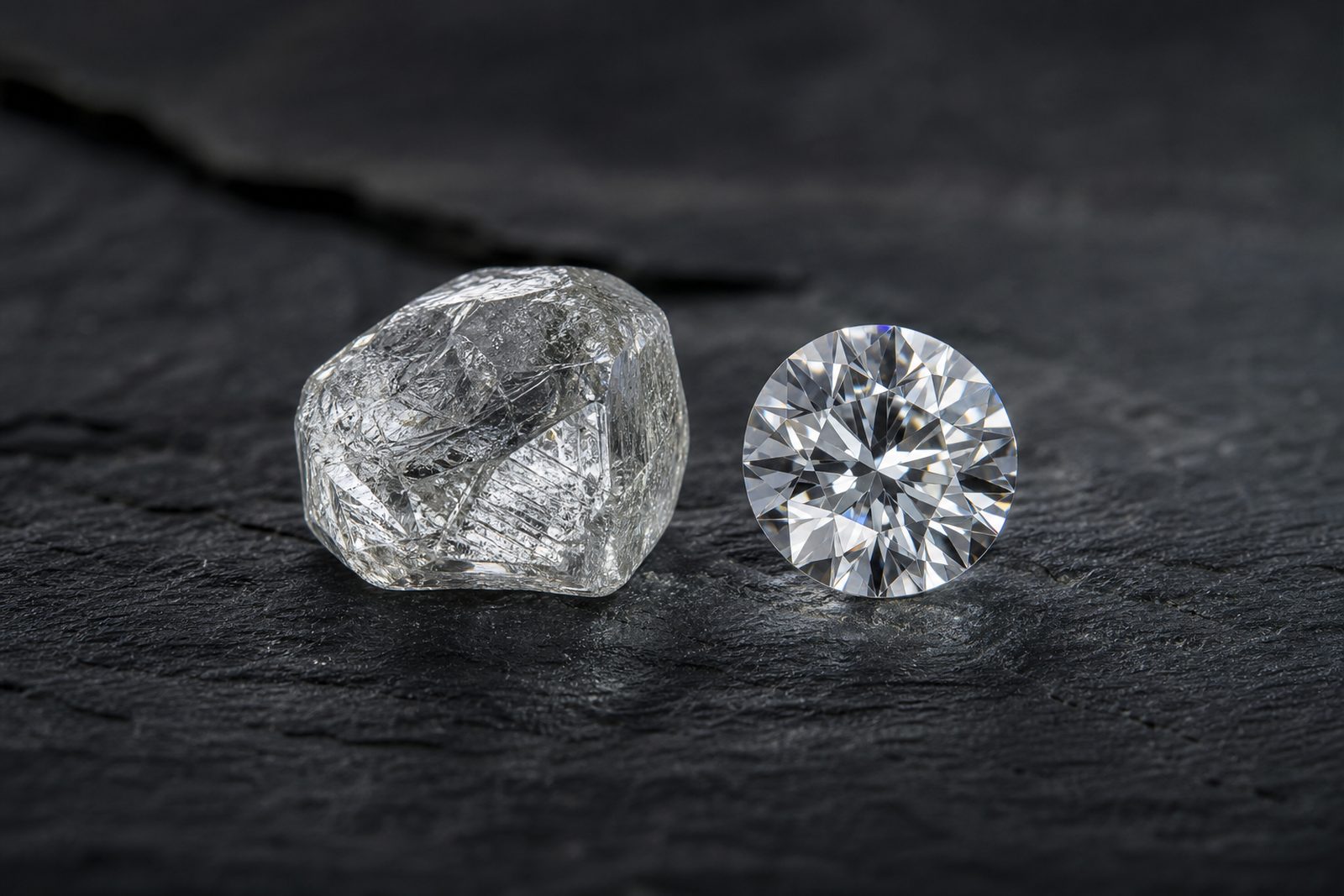
The honest starting point.
Most South African jewellers either refuse to discuss lab-grown ("we only carry natural") or push it hard on margin ("80% off mall pricing"). Both are commercial positions dressed up as advice. The honest starting point is that a lab-grown diamond is chemically and optically the same as a natural diamond. The differences are provenance and economics. The right answer for any particular buyer depends on which of those they value.
When natural makes sense.
- An heirloom you intend to keep. Natural diamonds hold a portion of their value across generations because supply is finite. They will not appreciate the way a Patek Philippe might, but they hold a market-clearing floor.
- An engagement piece you want to upgrade later. Prodiam's trade-in route applies to natural stones with the original GIA report. The credit on trade-in is benchmarked to the day's Rap reading. Lab-grown does not have a meaningful trade-in market. This is the usual brief for a custom engagement ring.
- A piece you value for its provenance. A South-African-cut natural diamond from a DBCM Emerging Beneficiation Customer carries a documented chain of custody from mine to setting, all on one continent, by identifiable people. That is a real and rare thing.
- You are comfortable paying for that finiteness. A 1.00 ct natural F/VS1 sells in the region of R 72 000 to R 80 000 excl. VAT cutting-house-direct, the level our own diamond range carries. The lab-grown equivalent now retails for roughly R 9 000 to R 12 000, and it keeps falling. The premium is for finiteness and provenance, nothing else.
When lab-grown makes sense.
- A fashion piece you want big. Drop earrings, tennis bracelets, statement cocktail rings: where carat weight on the wrist or neck is the point, lab-grown gives you 4x to 8x the visible stone for the same budget. We will design and set lab-grown into bespoke pieces if that is the brief.
- A first-engagement piece on a tight budget, with the conscious understanding that the carat-equivalent natural will be available later as an upgrade. Some couples do exactly this.
- An anniversary or eternity band where the stones are accent diamonds rather than a single centre stone, and the buyer wants the look of two carats of side melée for a fraction of the cost.
- You are not optimising for trade-in value or generational hold. Lab-grown prices have fallen by roughly 85 to 90% over the past decade, and they continue to soften. A lab-grown stone bought today will very likely be quoted lower in five years. That is fine if it is not the point of the purchase.
The lab-grown price collapse, in numbers.
Most retail-facing lab-grown copy is silent on the price trajectory. The trajectory is the single most important piece of context for a buyer. A one-carat lab-grown round that cost around 5 500 US dollars in 2016 retails for roughly 560 dollars today, a fall of about 90% in a decade, while a natural stone of the same spec has held the bulk of its value.
| Year | 1ct lab-grown, retail (USD) | Change |
|---|---|---|
| 2016 | $ 5 500 | baseline |
| 2018 | $ 4 000 | -27% |
| 2020 | $ 3 400 | -15% |
| 2022 | $ 1 800 | -47% |
| 2024 | $ 900 | -50% |
| 2026 Q2 | $ 560 | -38% |
Lab-grown figures are one-carat round, near-colourless, VS-clarity retail midpoints, drawn from Paul Zimnisky's lab-grown analysis and the StoneAlgo and PriceScope lab-grown price indices, 2016 to 2026. Wholesale trades materially lower again, under roughly 200 US dollars per carat in 2026.
The natural line is one-carat F/VS1 at cutter-direct level, anchored to our own diamond range; natural has eased modestly over the same period but holds a real resale floor, where lab-grown has no meaningful trade-in market. If a buyer is told today's lab-grown ticket reflects the stone's "value", they should know what that means in a continuously deflating commodity.
How to read a lab-grown report against a natural one.
Both natural and lab-grown stones are graded by the same labs (GIA, IGI, HRD, GCAL) on the same 4Cs scale. The report itself looks similar but has three tells:
- The header. Lab-grown reports are titled "Laboratory Grown Diamond Report" or "Synthetic Diamond Report"; naturals are titled "Diamond Grading Report" or "Diamond Dossier".
- The girdle inscription. Lab-grown stones above 0.50ct are laser-inscribed on the girdle with a "LG" prefix or "LAB GROWN" callout. Naturals carry only the report number.
- The "Origin" or "Growth Method" field. Lab-grown reports name the growth process (CVD or HPHT) and the post-growth treatment if any (LPHT annealing). Naturals do not have this field.
If a seller refuses to put a report in your hand, walk away. Both kinds of stone come with reports as a matter of course at retail.
What Prodiam will and will not do with lab-grown.
Will:
- Explain the difference honestly, including where lab-grown is genuinely the better answer for a given budget and brief.
- Point you to a reputable lab-grown specialist if that is what you want. We would rather you bought well elsewhere than badly from us.
- Tell you plainly when a natural stone is not the right call.
Will not:
- Mix lab-grown and natural stones in one piece without explicit written disclosure.
- Sell a lab-grown stone to a buyer who has asked for a natural, regardless of price difference.
- Cut a lab-grown stone at Procut DCW. The cutting works runs natural rough only, by SADPMR licence and by choice.
Want to look at both side-by-side?
Email darren@prodiam.co.za with the brief. We can put a natural and a lab-grown of the same spec on the same tray under the same loupe, with both reports and both prices on the day. You can decide for yourself which trade-off you actually want.