
Lab-Grown vs Natural · South Africa
Lab-grown vs natural diamonds, decided on the facts that matter.
A lab-grown diamond is a real diamond, same chemistry, same look, grown in a reactor in weeks. A natural diamond formed in the earth over a billion years and exists in finite supply. That one difference drives everything that follows: price, how the price moves over time, and whether the stone holds its value.
Prodiam is a South African cutting house, and we work in natural diamonds only, bought as rough, cut on our own bench in Bedfordview, sold direct. Here is the honest comparison, and exactly why we made that choice.
Get a fully-landed ZAR price to your spec Talk to Darren → Read the full lab-grown essay →
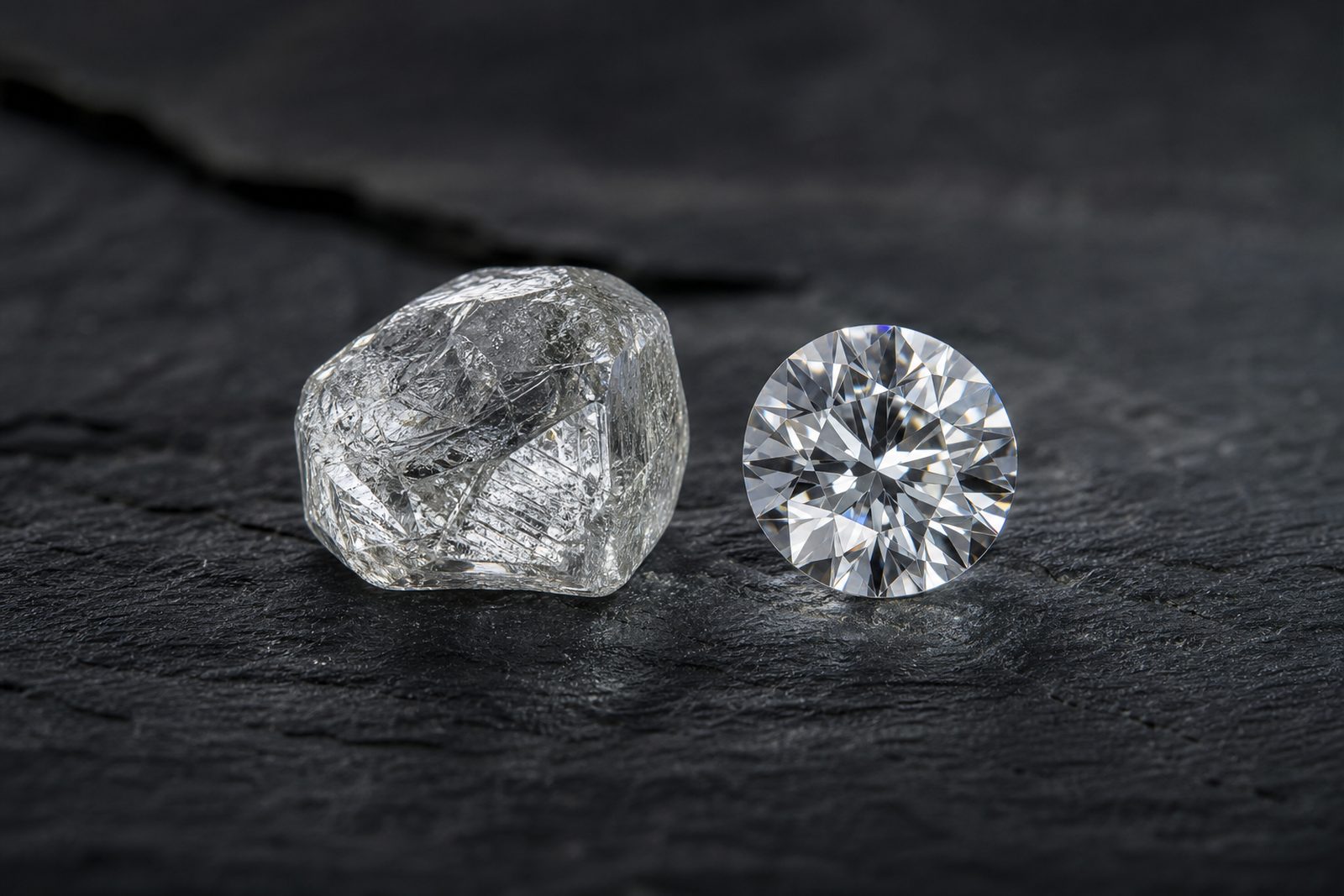
The real difference, in one sentence
Put a lab-grown and a natural diamond of the same grade side by side and no one, not even a jeweller, without specialist equipment, can tell them apart by eye. They are both pure crystallised carbon, and a lab-grown stone is a genuine diamond, not a simulant like cubic zirconia or moissanite.
The difference is not in the stone you see; it is in where it came from and what that does to its price over time. A natural diamond is finite, formed once, deep in the earth, over one to three billion years, and there is only so much of it.
A lab-grown diamond is manufacturable, grown to order in a chamber in a few weeks, and producible without limit. Every honest consideration below flows from that single distinction.
Natural vs lab-grown, row by row
| Natural | Lab-grown | |
|---|---|---|
| Origin | Formed in the earth over 1–3 billion years; finite supply | Grown in a reactor (CVD or HPHT) in a few weeks; unlimited supply |
| Value retention | Holds a market-clearing floor; finite supply underpins it; tradeable | No meaningful resale or trade-in market; value not the buying premise |
| Price trajectory | Broadly stable to firm over the long run; tracks finite supply | Fallen sharply as production scaled; trend still downward |
| Price today | Higher per carat; the premium pays for finiteness and provenance | A fraction of natural per carat; more visible carat for the same spend |
| Certification | GIA “Diamond Grading Report”; no growth-method field | GIA “Laboratory-Grown” report; “LG” girdle inscription >0.50ct |
| What Prodiam offers | Cut in-house to GIA Excellent cut grade, sold cutter-direct | Not supplied, we work in natural diamonds only |
Neither column is the “right” answer in the abstract. The right answer depends on what you are buying the stone for, and the most useful thing a comparison can do is be honest about the trade-offs rather than sell you one side.
The honest considerations
- Value retention. A natural diamond holds a resale floor because supply is finite and a real secondary market exists; you can trade it in against its original GIA report. A lab-grown stone has effectively no resale or trade-in market, it is bought to be worn, not held.
- Price trajectory. This is the consideration most often left out. Because lab-grown stones can be made on demand, wholesale prices have fallen heavily as capacity grew and the direction of travel is still downward. A lab-grown stone bought today will most likely be quoted lower in a few years. Natural pricing, tied to finite supply, has been far steadier over the long run.
- Certification. Both can be GIA-graded on the same 4Cs scale, but a lab-grown report is explicitly headed “Laboratory-Grown” and names the growth method; naturals carry a standard grading report. Whichever you choose, insist on the report and verify the number yourself.
- The emotional and heirloom angle. For many buyers this is the deciding factor and it is entirely legitimate. A natural diamond carries a billion-year, finite-supply story and a documented chain of custody you can pass on; a lab-grown stone, made to order, simply does not have that. If the piece is meant to be kept or handed down, that weight matters. If it is a fashion piece where size is the point, it may not.
Prodiam’s position, stated plainly
We are not neutral, and it would be dishonest to pretend otherwise, so here it is in writing. Prodiam works in natural diamonds only. We are a South African dealer and cutting house: we buy natural rough at De Beers DBCM viewings, South African tender houses and from independent diggers, cut and polish it ourselves at Procut DCW in Bedfordview to GIA Excellent cut grade, and sell it direct.
That is the rough-to-ring route and one chain of custody, where we buy the rough and cut it ourselves, from the rough stone to the finished ring, by people you can name.
We chose natural for two reasons, both of which the comparison above explains. First, value retention: the case for a diamond holding any of its worth rests on finite supply, and only natural has it. Second, the provenance story: a South-African-cut natural diamond carries a real, documented origin that we can stand behind, and that a reactor cannot replicate.
None of this is a knock on lab-grown as a category; it is a genuinely good choice for a buyer who wants maximum visible carat and is not optimising for resale. It is simply not what we make, and we would rather tell you that than sell you something we do not believe in for your brief.
How a natural diamond reaches you, rough to ring
- 01
Buy the rough
Natural rough acquired at De Beers DBCM viewings, SA tender houses and from independent diggers, the start of a single, documented chain of custody.
- 02
Cut in-house
Cut and polished on our own bench at Procut DCW in Bedfordview, to GIA Excellent cut grade. No stone leaves our custody to be worked elsewhere.
- 03
Certify & verify
Each stone is GIA or EGL certified, GIA primary. You receive the report and can verify the number yourself on the GIA report-check service before you commit.
- 04
Quote & deliver
Priced cutter-direct, referenced to the Rapaport wholesale list, with a firm ZAR figure before any work begins. Insured overnight delivery nationwide; remote buyers by video and WhatsApp.
What a natural diamond costs, and how the price is built
We do not publish a rand figure on a page, because no honest one exists in the abstract: a diamond is priced on its own 4Cs, carat, colour, clarity and cut, read against the Rapaport wholesale list, then the setting and metal on top. What we can tell you is where the money goes.
Buying from the people who cut the stone removes the layer of retail markup that sits between a mall counter and the diamond, so more of what you pay is in the stone itself. As a rule of thumb, a near-colourless, eye-clean one-carat round is the most-requested natural specification in South Africa, and cutter-direct is where it is keenest.
For the actual number on the actual stone, the live diamond search shows fully-landed ZAR prices, or we will quote you firm.
When you are ready to see real stones, browse our loose diamonds or the GIA-certified diamonds currently on the bench, search the live inventory for fully-landed ZAR pricing, or tell us your brief and Darren will come back within 24 hours. If you want the long-form argument, the full lab-grown stance essay sets out when each option genuinely makes sense.
Lab-grown vs natural: common questions
What is the real difference between a lab-grown and a natural diamond?
Chemically and optically, none, both are pure crystallised carbon, and a lab-grown stone is a real diamond, not an imitation. The difference is origin and economics. A natural diamond formed deep in the earth over one to three billion years and exists in finite supply; a lab-grown diamond is made in a reactor in a few weeks (by CVD or HPHT) and can be produced without limit.
That single fact, finite versus manufacturable, is what drives every other difference: price, price trajectory and how each holds value over time.
Do lab-grown diamonds hold their value?
Generally no, and this is the honest part most sellers skip. Because lab-grown stones can be made on demand, wholesale prices have fallen heavily as production scaled, and the trajectory has been steadily downward, a lab-grown stone bought today is likely to be quoted lower in a few years. There is also no meaningful resale or trade-in market for them.
A natural diamond will not appreciate like a rare watch, but because supply is finite it holds a market-clearing floor and can be traded in against its original certificate. If retained value matters to you, that gap is the whole decision.
Does Prodiam sell lab-grown diamonds?
No. Prodiam works in natural diamonds only. We buy natural rough at De Beers DBCM viewings and South African tender houses, cut and polish it ourselves at Procut DCW in Bedfordview to GIA Excellent cut grade, and sell direct, a single chain of custody from rough to finished ring. We made that choice deliberately, because the value-retention case and the provenance story both rest on a natural stone.
We will give you straight, non-preachy guidance on lab-grown as a category, but it is not what we supply.
Are natural diamonds a better investment?
It is more accurate to call a natural diamond a store of value than an investment, neither lab-grown nor natural is a growth asset, and you should never buy either expecting a return. What a natural diamond does offer is a finite-supply floor, a real secondary market, and a trade-in route against its GIA report, none of which a lab-grown stone has.
Buying cutter-direct also removes the retail markup, so more of what you pay sits in the stone itself. For a piece you intend to keep or pass on, that combination is why natural holds up; for a purely fashion piece, value retention may simply not be the point.
Are both lab-grown and natural diamonds GIA certified?
Both can be graded by the GIA on the same 4Cs scale, but the report is not the same document. A lab-grown stone receives a "Laboratory-Grown Diamond Report" that names the growth method (CVD or HPHT), and stones above 0.50ct are laser-inscribed on the girdle with a "LG" or "LAB GROWN" callout. A natural stone receives a standard "Diamond Grading Report" or dossier with no growth-method field.
Our natural diamonds are GIA or EGL certified, GIA primary, and you can verify any report number yourself on the GIA report-check service before you commit.
-
Natural diamonds only
We sell natural diamonds and diamond-set jewellery. Ask us about the grading report and available origin documentation for your chosen stone. Why we don’t sell lab-grown →
-
Independent grading reports
The grading laboratory is shown per stone. Review its report and the individual diamond before choosing; sourced examples can include GIA, EGL and IGI.
-
Same-address GIA verify
GIA South Africa office is in our building. On-the-spot re-grading on request before settlement.
-
14-day in-person exchange
In-person sales at the viewing room come with a 14-day exchange courtesy on stock pieces. Distance-sale CPA cooling-off applies.