
Engagement Ring Cost · Cutter-Direct, Bedfordview
Diamond engagement ring price and cost in South Africa, explained.
What an engagement ring costs, by centre stone
An engagement ring's total is the centre diamond plus the setting, metal and making. In our captured H-colour sample, a one-carat stone was about R60 800, a 1.5ct about R149 200 and a two carat about R334 400. These are diamond-only guide prices at VS1–VS2 clarity, with an Excellent cut filter and no fluorescence. We quote your complete ring before work begins.
| Centre stone | H-colour guide | J-colour guide | At capture | |
|---|---|---|---|---|
| half carat | R12 700 | R10 100 | 49 524 | See these → |
| 1 carat | R60 800 | R42 900 | 33 590 | See these → |
| 1.5 carat | R149 200 | R104 100 | 14 857 | See these → |
| 2 carat | R334 400 | R199 200 | 8 045 | See these → |
| 3 carat | R887 800 | R549 400 | 3 045 | See these → |
Both columns show sampled guide prices, not an entry price or a complete ring. The count includes all grades in each weight band at capture. Set a budget for the whole ring, then choose the diamond and setting together.
No two diamonds are the same
A table describes a market, not a stone. Two diamonds identical on paper can differ by a third in price and both figures be right: how well the stone is actually cut and how much light it returns, where the inclusions sit and whether the eye finds them, how strongly it fluoresces, and how keenly that one happens to be priced against the international trade benchmark on the day. We check every stone against that benchmark before we show it to anybody, and the number that matters is the one quoted in writing on the stone you actually choose.
Ask us what your budget buysSearch the live inventory →
Captured 19 October 2026; guide figures rounded up to the next R100. Colour and clarity tables use sampled medians and percentile bands; rows without a measured range may use a limited lower-priced sample. Prices and availability can change. Your written quote identifies the actual stone and all inclusions.
Diamond price guidance, captured 19 October 2026. These figures describe samples of sourced listings, with VAT and delivery for the stones included. They are not current stock guarantees. Settings and making are additional where jewellery is discussed; confirm the complete written quote.
A diamond engagement ring price in South Africa includes the centre diamond, any side stones, the setting, metal and making. As a dated diamond-only guide, the H-colour, VS1–VS2 sample median for a 1.00–1.09 ct stone was R60 800 on 19 October 2026, including VAT and delivery. The complete ring costs more: send your design and total budget for an itemised quote.
This is an honest breakdown of where the money goes, where it goes furthest, and why buying direct from Prodiam puts more ring in front of you for the same budget. Every Prodiam ring is made to order in our Bedfordview, Johannesburg workshop, with the centre stone cut on our own bench or sourced to order, and quoted firm in rand before any work begins.
Get a firm quote to your budget Get a fully-landed ZAR price to your spec → Email Darren directly →
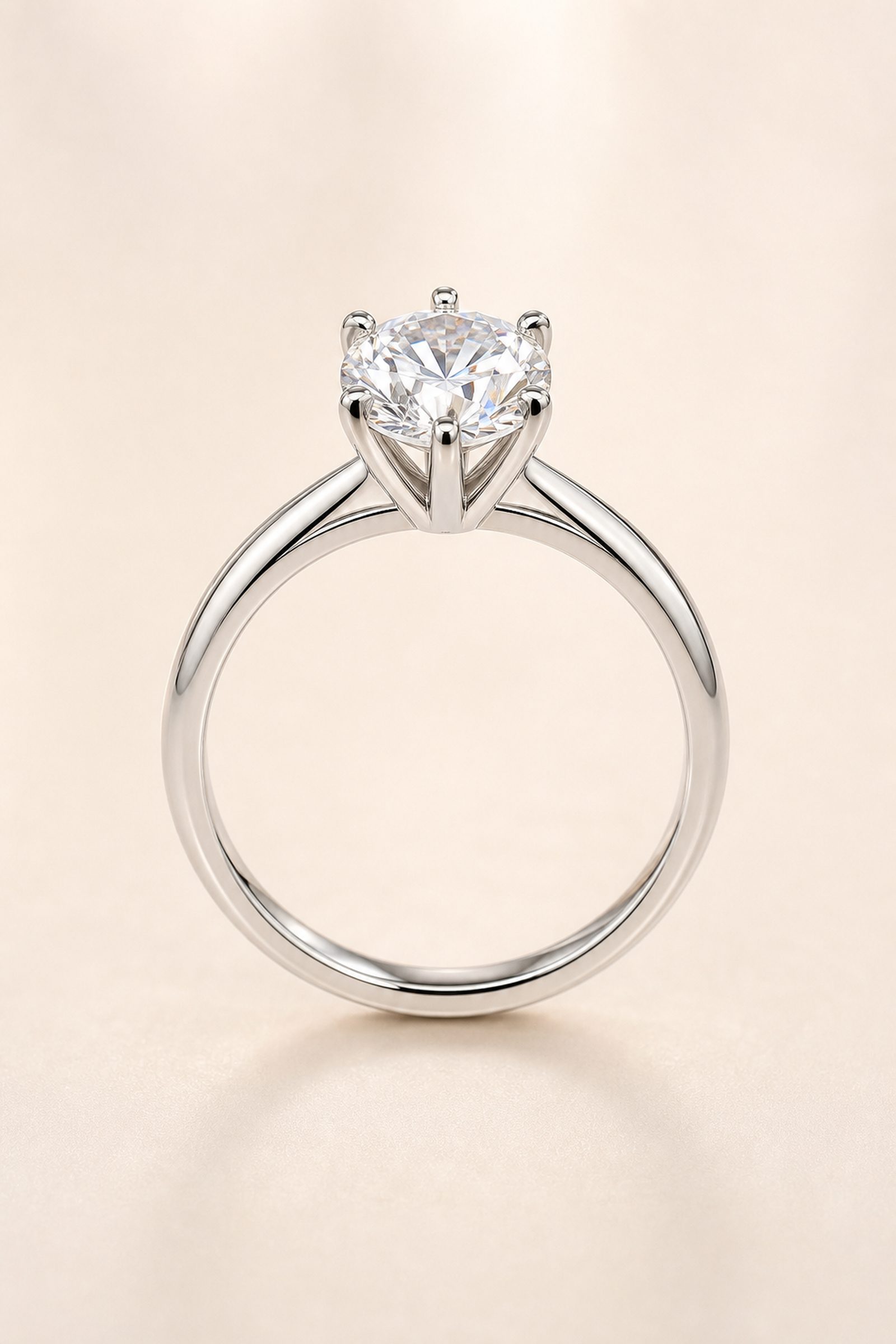
Where the money actually goes
A diamond engagement ring is not one purchase; it is four, bundled into one ring. Understanding the four parts is what lets you spend deliberately rather than be sold up on the part that shows least.
The centre diamond is the heart of the cost and the part with the widest range, two stones of identical carat weight can sit far apart in price on the strength of their cut, colour and clarity alone. The metal, the setting and making, and the certification are real costs too, but they are smaller and far more predictable.
Here is what you are paying for, and what each part is sensitive to.
| What you’re paying for | Notes |
|---|---|
| The centre diamond (the big variable) | Set by the 4Cs against the Rapaport wholesale list. Carat weight and cut drive the figure hardest; colour and clarity adjust it. Polished to GIA Excellent cut grade on our own bench. Cutter-direct removes the retail markup on this, the largest part. |
| The metal (mount) | 18k white, yellow or rose gold, or platinum. Priced on the gram weight of the mount and the metal market on the day. Platinum is denser and sits above gold per gram; a heavier or more intricate mount uses more metal. |
| The setting & the making | The bench labour to build, cast, set and hand-finish the ring. A solitaire is the least; a pavé band, a hidden halo or fine micro-setting carries more hours and more melee diamonds. |
| Side & accent diamonds | Halo, pavé or three-stone designs add matched melee or shoulder stones, each cut and matched in-house. The more diamonds on the ring, the more this part grows. |
| Certification | The GIA (primary) or EGL report on the centre stone, plus a written insurance valuation on request. A fixed, modest line against the whole. |
Notice what is missing: there is no rand figure in that table, and there should not be. A number quoted before the stone is chosen is either a guess or a hook. What we can tell you is how each part behaves, then put real stones in front of you, quoted to the rand, so the price is a fact, not a forecast.
What does a 1-carat diamond ring price come to in rand?
For an honest anchor rather than a hook: the centre stone is the biggest line by a wide margin, and a 1-carat, well-cut centre (F colour, VS1 clarity, GIA Excellent cut) runs roughly R78 000 to R92 000 ex VAT at our cutter-direct level, then the setting and metal go on top. That is the diamond engagement ring price most first-time buyers are really asking about. Move the spec and the figure moves with it: a smaller carat weight or a near-colourless face-up colour brings it down, a larger or rarer stone takes it up. The exact diamond ring price for your brief is set against the Rapaport reference for that size and grade, costed with the metal and making, and quoted firm before any deposit.
To see how that 1-carat anchor is built from the ground up, our diamond price per carat in South Africa page shows how price scales with weight, and the 1-carat diamond price in South Africa page sets out exactly what a one-carat stone costs cutter-direct before it is set into a ring.
Spend on cut and carat, where the budget goes furthest
Once you see the four parts, the value route is clear, and it is the same advice we give every client across the bench:
- Cut comes first, and never moves. A stone polished to GIA Excellent cut grade returns the most light and reads the largest and brightest for its weight. A poorly cut stone of greater weight can look smaller and duller. This is the one part of the 4Cs we never compromise.
- Carat is what people notice. Face-up size is the thing the eye reads first, so after cut is locked, carat is usually where the rest of the budget should go. Buying just under a round weight can stretch it a little further without a visible difference.
- Colour: near-colourless faces up white. A near-colourless grade (around G–H) looks white once set, particularly in white metal. Paying for a top colourless grade rarely shows to the eye, so it is the easiest place to be sensible.
- Clarity: eye-clean is the target. A stone whose inclusions you cannot see without a loupe looks identical to a flawless one at arm’s length. Eye-clean, not flawless, is the value grade.
Put together: hold cut at GIA Excellent, choose an eye-clean clarity and a near-colourless face-up colour, and direct the remaining budget into carat. That single rule decides most of where the money goes furthest. For the full picture of how the grades interact, our guide to the 4Cs of diamond grading walks through each in turn, and how to read a GIA report shows you how to verify the stone you are quoted.
Setting a budget sensibly
The honest way to set a budget is to start from a number you are comfortable with, not from a stone you have fallen for online. Old “two or three months’ salary” rules are marketing, not maths, the right budget is simply what fits your life, and a good diamond house works backwards from it rather than selling up from it.
Decide the figure, then let the spec flex to fit: cut stays at Excellent, and carat, colour and clarity are balanced to put the most ring in front of you. If the spec you had in mind does not fit, a straight answer and an alternative that does is worth more than a stretch you regret.
Tell us the budget and it becomes the brief; the quote comes back firm, in rand, before you commit anything.
Cutter-direct versus retail, the same stone, fewer hands
The single biggest lever on the price of an engagement ring is not the spec, it is how many hands the diamond passes through before it reaches you.
A retail ring typically travels from rough buyer to cutter to wholesaler to importer to retailer, and each hand adds a margin, so the same GIA-graded stone can carry a markup well north of half its wholesale cost again by the time it reaches a chain counter.
A cutting house that buys its own rough and polishes its own stones collapses those layers into one operation: the pricing is polished-cost-plus, not wholesale-times-a-multiple. Prodiam buys rough at De Beers DBCM viewings and SA tender houses, cuts and polishes it in-house on our Bedfordview bench, and sells direct, the same Rapaport list as everyone, far fewer hands against it.
The verifiable test of any “no middleman” claim is to ask who polished the stone; our guide to wholesale versus retail diamond pricing sets out exactly where the margin sits.
How a ring is priced and made to order
- 01
Brief & budget
You tell us the budget, the carat band, colour and clarity range, cut, shape, metal and setting style. The budget is the brief. We respond within 24 hours.
- 02
Stones & firm quote
We put two or three candidate diamonds in front of you, each held against its Rapaport reference, with the metal and making costed, a firm rand figure, VAT inclusive, before any deposit.
- 03
Design sign-off
A CAD rendering of the ring with your chosen stone. On sign-off the setting commission is fixed and the full price is locked. Nothing moves after this gate.
- 04
Cut, set & finish
The centre stone cut to GIA Excellent on our Bedfordview bench or sourced to that grade, the mount cast in your chosen metal, every stone set at the bench and hand-finished, then checked under loupe and microscope.
- 05
Hand-over
Presentation at Bedfordview by appointment, or insured overnight courier nationwide via Brink’s or G4S. GIA / EGL certification and a written insurance valuation on request.
When you are ready, the fastest route to a real number is to search our live diamond inventory, where you can see fully-landed ZAR prices on certified stones, or to browse the loose diamonds currently on the bench and the GIA-certified diamonds we hold. From there, a ring is one custom engagement brief away.
If you would rather talk it through first, meet the dealer and bench behind the price, then send Darren your budget and he will come back within 24 hours.
Diamond engagement ring price and cost: common questions
What does a 1-carat diamond engagement ring cost in South Africa?
As an honest anchor, the centre stone is the biggest line by far, and a 1-carat, well-cut centre diamond (F colour, VS1 clarity, GIA Excellent cut) runs roughly R78 000 to R92 000 ex VAT at our cutter-direct level. The setting and metal then go on top: 18k gold or platinum priced on the mount weight, plus the bench making and certification.
So a finished 1-carat diamond engagement ring price is built from that centre-stone figure plus the mount and making, not a single sticker number. Move the spec and the figure moves with it, a smaller carat or a near-colourless face-up colour brings it down, a larger or rarer stone takes it up.
We hold the stone against the Rapaport reference for its size and grade and quote the whole ring firm in rand, VAT inclusive, before any deposit. For the stone on its own, see our 1-carat diamond price in South Africa page.
What makes up the cost of a diamond engagement ring?
Four parts. First and largest, the centre diamond, its price is set by the 4Cs (carat weight, colour, clarity and cut) against the Rapaport wholesale list, so two stones of the same carat can differ widely in price. Second, the metal: 18k white, yellow or rose gold, or platinum, priced on the gram weight of the mount and the metal market on the day.
Third, the setting and the making, the bench labour to build, cast, set and finish the ring. Fourth, certification, the GIA or EGL report on the centre stone. Because we cut our own stones on our Bedfordview bench and sell cutter-direct, you pay a landed stone price plus transparent making, not a retail markup on top of all four.
We quote the whole figure firm in rand, VAT inclusive, before any work begins.
How do I get the best value for my budget?
Spend where the eye actually reads it. Cut comes first, a stone polished to the GIA Excellent cut standard, on our own bench where we cut the stone returns the most light and looks the largest and brightest for its weight, so it is the one part of the 4Cs we never compromise. Carat next, because face-up size is what most people notice.
On colour, a near-colourless grade (G–H) faces up white once set, especially in white metal, so paying for a top colourless grade rarely shows. On clarity, an eye-clean stone with inclusions you cannot see without a loupe looks identical to a flawless one at arm’s length.
So the value route is: hold cut at Excellent, choose an eye-clean clarity and a near-colourless face-up colour, and put the rest of the budget into carat. We will show you two or three stones at that brief, quoted to the rand, so you can see the trade-off rather than take it on trust.
Is it cheaper to buy a diamond engagement ring direct from a bench?
Yes, structurally. A retail ring usually passes through several hands between the rough and the counter, rough buyer, cutter, wholesaler, importer, retailer, and each takes a margin, so the same GIA-graded stone carries a markup of roughly 60 to 120% or more over wholesale acquisition cost at a chain.
A cutting house that buys its own rough and polishes its own stones collapses those layers into one, so the structure is polished-cost-plus rather than wholesale-times-a-multiple. Prodiam buys rough at De Beers DBCM viewings and SA tender houses, cuts and polishes it in-house on our Bedfordview bench, and sells direct, the same Rapaport list, far fewer hands against it.
The honest test of any “no middleman” claim is simple: ask who polished the stone.
Do you quote a firm price before I commit?
Always. There is no obligation in getting a quote. You tell us the brief, carat band, colour and clarity range, cut, shape, metal, setting style and your budget, and we come back with two or three candidate stones and a ring quoted firm in rand, including VAT.
The stone price is held against the Rapaport reference for that size and grade, the metal is costed on the mount weight, and the making is a fixed bench figure. Nothing moves once you sign off the design: the setting commission is fixed at sign-off, and you know the full figure before any deposit is paid.
Can you work to a set budget?
Yes, most commissions start from a number, not a stone. Tell us what you want to spend and we work backwards: we hold cut at GIA Excellent, then balance carat, colour and clarity to put the most ring in front of you for that budget, and we show you the trade-offs honestly rather than quietly cutting the part you would have noticed.
If the spec you have in mind does not fit the budget, we will say so and show you what does. The budget is the brief; the quote is firm before you commit a cent.
-
Natural diamonds only
We sell natural diamonds and diamond-set jewellery. Ask us about the grading report and available origin documentation for your chosen stone. Why we don’t sell lab-grown →
-
Independent grading reports
The grading laboratory is shown per stone. Review its report and the individual diamond before choosing; sourced examples can include GIA, EGL and IGI.
-
Insured delivery, SA & worldwide
Overnight across South Africa via Brink’s, G4S or our nominated jewellery courier. Insured worldwide dispatch via Ferrari Group and FedEx Custom Critical.
-
14-day in-person exchange
In-person sales at the viewing room come with a 14-day exchange courtesy on stock pieces. Distance-sale CPA cooling-off applies.