
Diamond Carat · Weight, Not Size · Cutter-Direct
Diamond carat weight and what it costs
See this size at true scale on your screen →
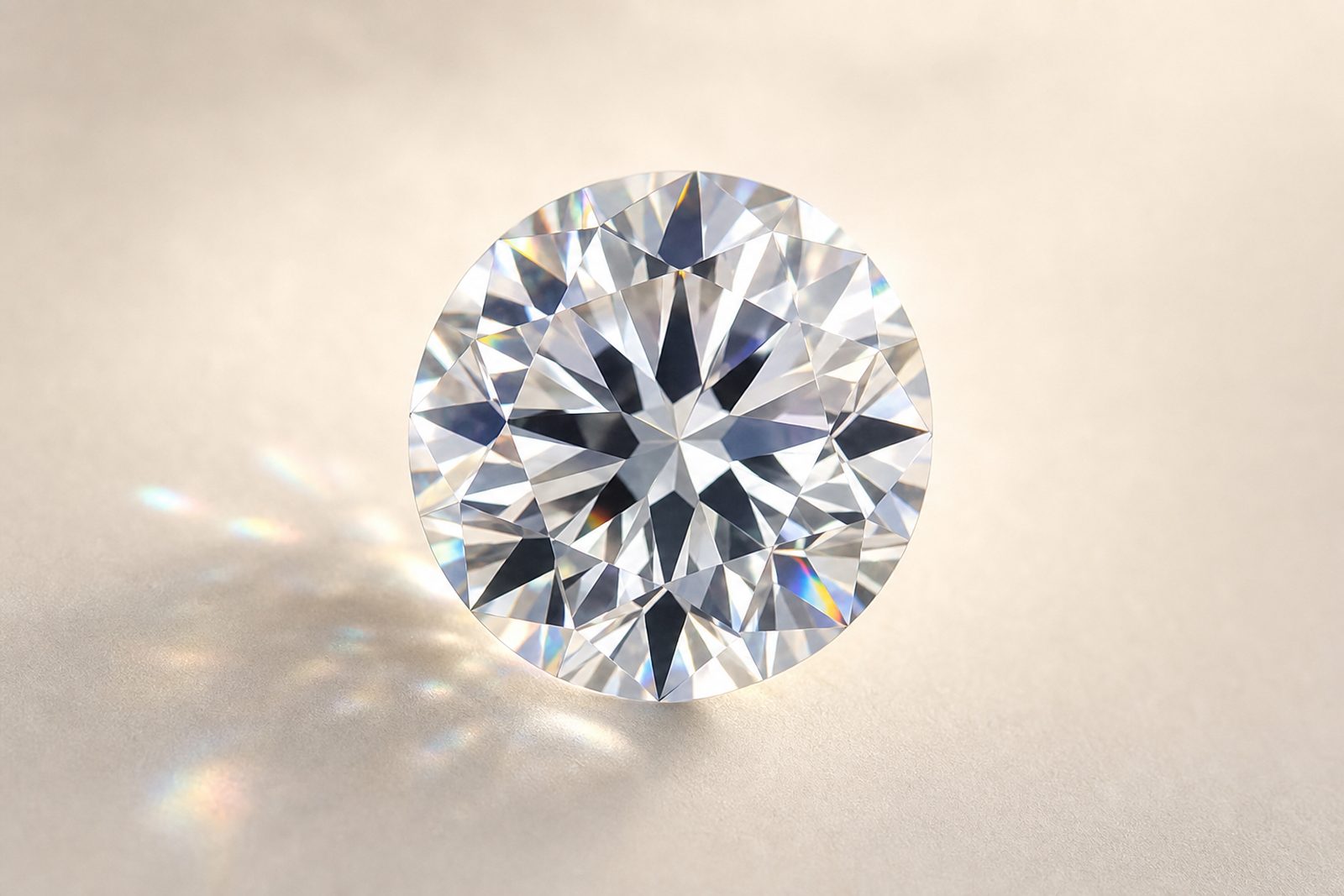
Carat is a measure of weight, not size. One carat is exactly a fifth of a gram, and it tells you what the diamond weighs, not how large it looks on a hand. Face-up size is set by the cut, which can carry weight as visible spread on top or hide it as dead depth underneath.
Carat also moves price more than any other grade, in a steep curve with sharp steps at the “magic numbers”, which is why the shy weights just below them are the value play. This guide explains carat versus size, the price curve, and how to buy weight without wasting money. Natural diamonds only.
See fully-landed ZAR prices by carat weight Ask which weight suits your budget → Email Darren directly →
-
Natural diamonds only
We sell natural diamonds and diamond-set jewellery. Ask us about the grading report and available origin documentation for your chosen stone. Why we don’t sell lab-grown →
-
Independent grading reports
The grading laboratory is shown per stone. Review its report and the individual diamond before choosing; sourced examples can include GIA, EGL and IGI.
-
Insured delivery, SA & worldwide
Overnight across South Africa via Brink’s, G4S or our nominated jewellery courier. Insured worldwide dispatch via Ferrari Group and FedEx Custom Critical.
-
14-day in-person exchange
In-person sales at the viewing room come with a 14-day exchange courtesy on stock pieces. Distance-sale CPA cooling-off applies.
Diamond price guidance, captured 8 September 2026. These figures describe samples of sourced listings, with VAT and delivery for the stones included. They are not current stock guarantees. Settings and making are additional where jewellery is discussed; confirm the complete written quote.
What carat weight actually costs
The captured guide prices were R12 400 for a half-carat and R61 300 for a one-carat at H colour. The nominal weight doubles while the sampled price increases roughly 5 times. The comparison uses VS1–VS2 clarity, an Excellent cut filter and no fluorescence. Each row covers a weight band rather than one exact carat weight.
| Weight | Typical price | Per carat | At capture | |
|---|---|---|---|---|
| half carat | R12 400 | R23 900 | 34 053 | See these → |
| 1 carat | R61 300 | R60 100 | 25 599 | See these → |
| 1.5 carat | R148 700 | R97 900 | 11 390 | See these → |
| 2 carat | R300 500 | R148 800 | 5 877 | See these → |
| 3 carat | R880 300 | R286 800 | 2 060 | See these → |
The per-carat column is the one worth reading twice. It is not a constant, it is what makes a 2 carat cost far more than two 1 carats. It is also why buying just under a milestone weight, a 0.96 rather than a 1.00, saves real money for a difference nobody can see on a hand.
No two diamonds are the same
A table describes a market, not a stone. Two diamonds identical on paper can differ by a third in price and both figures be right: how well the stone is actually cut and how much light it returns, where the inclusions sit and whether the eye finds them, how strongly it fluoresces, and how keenly that one happens to be priced against the international trade benchmark on the day. We check every stone against that benchmark before we show it to anybody, and the number that matters is the one quoted in writing on the stone you actually choose.
Ask us what your budget buysSearch the live inventory →
Captured 8 September 2026; guide figures rounded up to the next R100. Colour and clarity tables use sampled medians and percentile bands; rows without a measured range may use a limited lower-priced sample. Prices and availability can change. Your written quote identifies the actual stone and all inclusions.
The short answer: carat is weight, not size
The most common misunderstanding in diamond buying is reading carat as a measure of how big a stone looks. It is not. Carat is weight. One carat equals exactly 0.20 grams, or 200 milligrams, and it is split into 100 points, so a quarter-carat stone is a “25-pointer” and a 0.90ct is a “ninety-pointer”.
The unit traces back to the carob seed, whose remarkably consistent mass was once used to balance gem scales. What matters today is the distinction the word hides: weight is not the same as the size your eye actually sees.
Two diamonds can weigh an identical 1.00 carat and look noticeably different across a table, because one cutter spread that weight into a wide, bright top while another buried it in a deep base nobody can see.
Of the four Cs, colour, clarity and carat are properties the rough already held when it left the ground; carat is simply how much of that rough survived as a finished, certified stone.
Carat versus face-up size: the millimetres that matter
What your eye registers as “a big diamond” is not the weight on the certificate, it is the diameter across the top, the spread you see looking down at a ring. For round brilliants those figures are physical, well-established and worth knowing, because they let you picture a weight before you ever see the stone. A well-cut 1.00ct round brilliant measures roughly 6.4 to 6.5mm across.
| Carat (round brilliant) | Typical face-up diameter |
|---|---|
| 0.50 ct | about 5.0–5.2 mm |
| 0.75 ct | about 5.8–5.9 mm |
| 1.00 ct | about 6.4–6.5 mm |
| 1.50 ct | about 7.3–7.4 mm |
| 2.00 ct | about 8.1–8.2 mm |
Notice how slowly the millimetres climb. Diameter grows with the cube root of weight, so doubling the carat does not double the width: a 2.00ct stone is only about a quarter wider across the top than a 1.00ct, not twice as wide.
This is why two carats does not look “twice as big” on a finger, and why jumping a magic number buys a smaller visible gain than the price jump implies. Shape changes the picture again.
Elongated cuts, oval, marquise, pear and emerald, spread the same weight over a longer outline, so they read larger than their carat suggests, while a deep cushion or a thick-girdled round can hide weight and look smaller. Carat is the weight; size is what the cut does with it.
How a deep or shallow cut hides or wastes weight
Because carat is weight and size is diameter, a cutter can move weight to places your eye never sees. A stone cut too deep carries extra weight in a tall pavilion below the girdle, so it weighs a full carat but faces up like a 0.90ct, you paid for weight buried in the base.
A stone cut too shallow spreads wider than its weight for a moment, but leaks light through the bottom and goes glassy or dark in the centre, trading sparkle for a slightly larger footprint. A thick girdle, the band around the widest point, is another quiet weight-trap: it adds grams that hide in the setting and do nothing for face-up size.
This is the hidden link between carat and diamond cut: the right proportions put the weight where you can see it as a bright, full top, while bad proportions bank it where it is wasted. It is also why a well-cut 0.95ct can look every bit as large as a poorly cut 1.05ct, and far more alive. Weight on the certificate is not the same as weight on display.
The per-carat price curve, and why it is steep
Carat affects price more than any other single grade, and it does not rise in a straight line. Diamond value is the per-carat price multiplied by the weight, and the per-carat figure itself climbs as stones get larger, because large pieces of gem-quality rough are far rarer than small ones.
The trade prices against the Rapaport list, a per-carat price sheet in US dollars broken into weight bands and colour-clarity combinations. To reach a real South African figure, a dealer takes the relevant Rapaport price, applies a trade discount, converts the dollars to rand at the day’s exchange rate, and adds 15% VAT.
Two forces therefore compound: a heavier stone holds more carats and each carat costs more, so the curve bends upward steeply rather than doubling neatly with weight. That is the honest mechanism. It is also why we never publish a fixed rand price on a page like this: it would be stale the moment the rand or the list moved.
For fully-landed ZAR prices on real certified stones, see the diamond search, and for the most-asked weight, our guide to the 1 carat diamond price in South Africa walks through the maths on a single stone.
Magic numbers and the shy weights that beat them
On top of that rising curve sit sudden steps. The market anchors demand on round figures, and at each of these magic numbers the per-carat price jumps:
| Magic number | The shy weight that beats it |
|---|---|
| 0.50 ct | 0.45–0.49 ct, near-identical face-up for less per carat |
| 0.90 ct | 0.85–0.89 ct, a fraction narrower, priced below the step |
| 1.00 ct | 0.91–0.96 ct, the classic value play under the one-carat wall |
| 1.50 ct | 1.40–1.49 ct, the same look at a lower per-carat rate |
| 2.00 ct | 1.90–1.96 ct, a sliver smaller, materially cheaper |
The reason the steps exist is pure demand psychology: far more people ask for “a one-carat” than for a 0.95ct, so the round weights command a premium and the rough that yields them is bid up. The stones that fall just under a threshold are called shy weights, and they are the single most reliable value move in the whole purchase.
A 0.95ct round brilliant sits only about a tenth of a millimetre narrower than a 1.00ct, a gap no eye can read across a table, yet it can price meaningfully lower per carat. The same logic repeats at every threshold: a 1.94ct beside a 2.00ct, a 0.89ct beside a 0.90ct.
The smart brief is not “the smallest stone I can stretch to one carat”, it is “the largest stone I can buy in the shy band just below the next magic number”. That is how a cutting house thinks about budget, and it is set out further in our guide to the 4Cs.
How carat trades against cut, colour and clarity
On a fixed budget, carat is one of four levers, and the four constantly trade against each other. The mistake is to spend on carat first and let the grades fall where they may. The order a serious bench works in puts the visible money where the eye actually notices it:
- 01
Fix the cut first, before any talk of size
Lock in a GIA Excellent round-brilliant cut grade. It is the grade your eye reads first, it makes a stone look larger and brighter than its weight, and it can never be changed once the diamond is polished.
- 02
Drop colour to where the eye stops noticing
A near-colourless G to I colour faces up white in a ring, and in yellow or rose gold you can go lower still. The saving funds more carat or a better cut.
- 03
Drop clarity to genuinely eye-clean
An eye-clean VS2 or SI1 clarity stone looks identical to a flawless one face-up, for a fraction of the price. Read the GIA plot, then judge it at arm’s length.
- 04
Then buy the largest shy weight you can
With cut locked and the grades sensible, spend the rest on carat, choosing the biggest stone in the shy band below the next magic number. That is the most weight your money can show.
Worked through on a real stone against a real budget, that order consistently buys the largest, liveliest diamond your money can show on a hand, rather than the heaviest one on paper. Our certified stones come with the laboratory report you check yourself before you pay, taken as a loose diamond or set into a ring.
The cutter-direct view: never sacrifice cut for a magic number
As a working cutting house, Prodiam buys rough and polishes round brilliants to GIA Excellent cut grade on our own bench in Bedfordview, Johannesburg, so we plan exactly where a stone’s weight will land.
That gives us one firm view to leave you with: never sacrifice cut to hit a round number. A stone pushed to a full carat by deepening the pavilion or thickening the girdle weighs the magic number but faces up smaller and duller than a beautifully cut shy weight beside it, you have paid more for a worse-looking diamond.
The whole point of buying cutter-direct is that the same hand choosing the make also helps you choose the weight, against the real Rapaport-referenced, fully-landed price rather than a marketing round number.
Tell us your shape, metal and budget, and Darren shortlists real, GIA-certified stones at the cut grade and the shy weight that give you the most visible diamond for the money, then delivers it insured and overnight anywhere in South Africa. Natural diamonds only.
Diamond carat: common questions
What is a carat, and is it a measure of size?
A carat is a unit of weight, not size. One carat equals exactly 0.20 grams, or 200 milligrams, and it is divided into 100 points, so a 0.25ct stone is a “25-pointer”. The word comes from the carob seed once used to balance gem scales. The key thing for a buyer is that carat tells you what the diamond weighs, not how large it looks face-up.
Two stones of identical carat weight can present very differently across the table depending on how they are cut, because weight can be carried as visible spread on top or hidden as extra depth underneath. So carat is a precise, certified number, but it is only half the story of how big a diamond actually looks on a hand.
How big is a 1 carat diamond in millimetres?
A well-cut 1.00 carat round brilliant measures roughly 6.4 to 6.5mm across the top. That diameter is what your eye reads as “size”, and it is set by the cut, not just the weight. As a rough guide for round brilliants, a 0.50ct sits near 5.0 to 5.2mm, a 0.75ct near 5.8 to 5.9mm, a 1.50ct near 7.3 to 7.4mm, and a 2.00ct near 8.1 to 8.2mm.
Because diameter grows with the cube root of weight, doubling the carat does not double the face-up width; a 2.00ct stone is only about a quarter wider across the top than a 1.00ct, not twice as wide. Elongated shapes such as oval, marquise and pear look larger than their weight suggests because they spread the same mass over a longer outline.
What are diamond magic numbers and shy weights?
Magic numbers are the round carat weights the market anchors demand on: 0.50, 0.90, 1.00, 1.50 and 2.00 carat. At each of these thresholds the per-carat price steps sharply upward, because buyers ask for the round figure and the rough needed to reach it is scarcer.
Shy weights are the stones that fall just below a magic number, such as a 0.91 to 0.96ct sitting under 1.00ct, or a 1.90ct under 2.00ct. A shy stone is visually almost indistinguishable from the magic number above it, the diameter gap is a fraction of a millimetre, yet it prices materially lower per carat.
Buying the largest stone in the shy band below the next threshold is one of the most reliable value moves in the whole purchase, and it is exactly how the trade itself buys.
Does carat weight affect price, and how?
Yes, more than any other single grade, and not in a straight line. Diamond price is driven by the per-carat price multiplied by the weight, and the per-carat figure itself rises as stones get larger because big rough is rarer.
The trade references the Rapaport price list, quoted per carat in US dollars for each weight band and colour-clarity combination; a dealer applies a trade discount to that list, converts to rand, and adds 15% VAT to land the final price. The result is a steep curve with sharp steps at the magic numbers, so a 1.00ct can cost far more than its extra weight over a 0.95ct would suggest.
We do not publish fixed prices because they move with the dollar and the list; for firm, fully-landed ZAR figures on real certified stones, use the diamond search, and ask Darren for a firm written quote.
Should I choose a bigger diamond or a better cut?
Cut, every time the choice is forced. A smaller, beautifully cut stone out-sparkles a larger dull one, and cut is the only grade you can never change after the diamond is polished.
A 0.90ct GIA Excellent round brilliant faces up brighter and often looks larger than a 1.10ct stone of a lower cut grade, because a well-cut stone returns light to the eye while a deep, badly proportioned one hides its weight in the base where you cannot see it.
The cutter-direct rule is simple: fix the cut grade first, then choose the largest carat weight your budget allows in the shy band below the next magic number. Chasing a round number at the cost of the cut buys you a heavier stone that looks worse, which is the opposite of value.
Last reviewed: June 2026.