
Diamond Eternity Rings · South Africa · Cutter-Direct
Diamond eternity rings, and what they cost
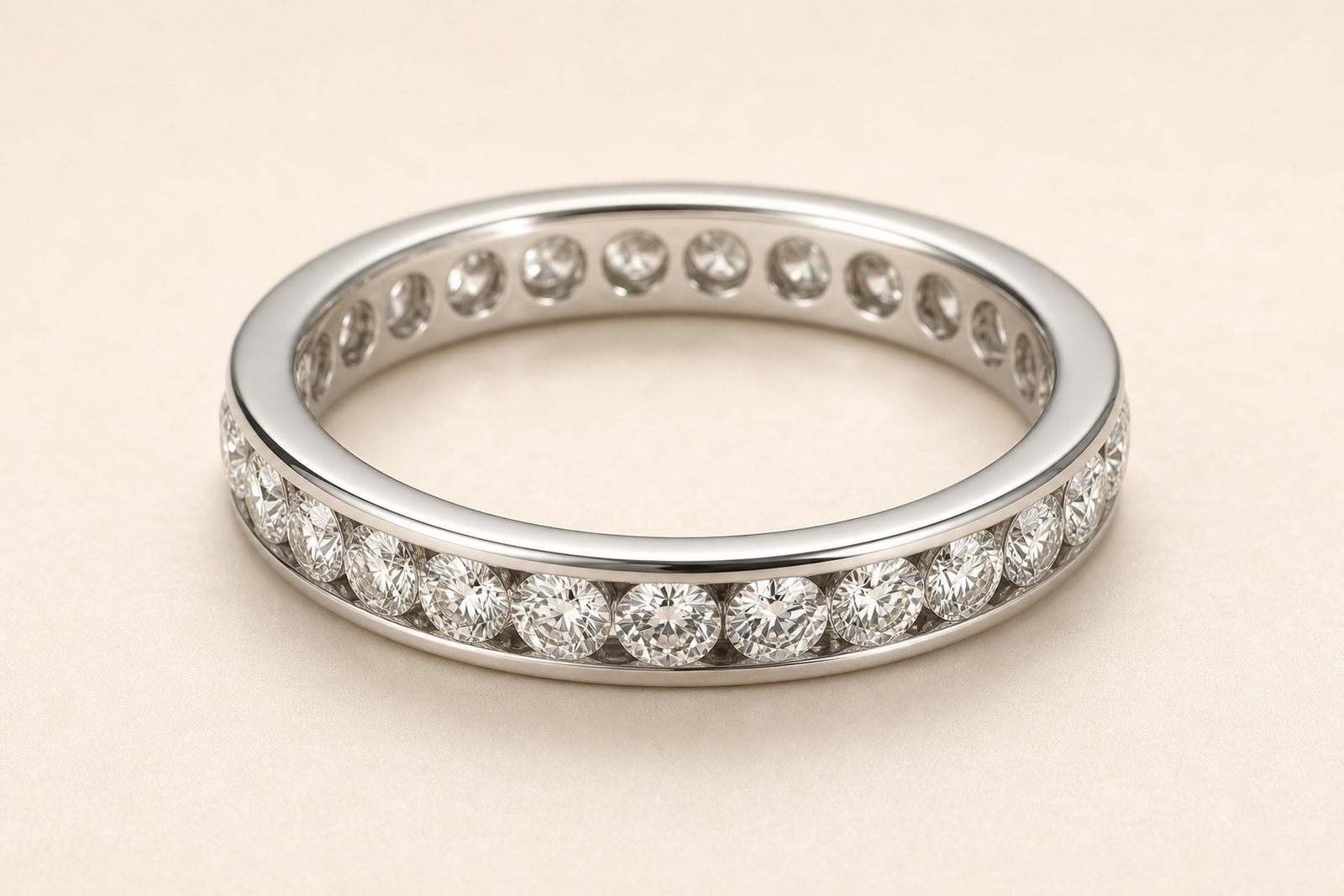
A diamond eternity ring is a band set with a continuous line of matched diamonds, full eternity right around, or half eternity across the top, worn most often as a wedding band, a milestone anniversary gift or a meaningful present. There is no single price: the figure is driven by the total carat weight across the row, how consistently the stones are matched, the metal and the setting.
This guide explains full versus half, how the price is built, and how to choose. Then we quote your exact ring, firm, in writing. Natural diamonds only.
Design your eternity ring Get a firm quote → Email Darren directly →
-
Natural diamonds only
We sell natural diamonds and diamond-set jewellery. Ask us about the grading report and available origin documentation for your chosen stone. Why we don’t sell lab-grown →
-
Independent grading reports
The grading laboratory is shown per stone. Review its report and the individual diamond before choosing; sourced examples can include GIA, EGL and IGI.
-
Insured delivery, SA & worldwide
Overnight across South Africa via Brink’s, G4S or our nominated jewellery courier. Insured worldwide dispatch via Ferrari Group and FedEx Custom Critical.
-
14-day in-person exchange
In-person sales at the viewing room come with a 14-day exchange courtesy on stock pieces. Distance-sale CPA cooling-off applies.
Diamond price guidance, captured 8 September 2026. These figures describe samples of sourced listings, with VAT and delivery for the stones included. They are not current stock guarantees. Settings and making are additional where jewellery is discussed; confirm the complete written quote.
Indicative diamond eternity-ring budgets
Our indicative calculation runs from about R12 000 for a 0.41ct band to R84 000 at 2.67ct, VAT included. An eternity ring is priced by the total carat weight of the line and the size of each stone, using a proportional estimate from the bracelet price register. These are budgeting illustrations, not measured ring specifications or confirmed offers.
| Stone size | Total weight | Indicative price | |
|---|---|---|---|
| 1.9mm | 0.41 ct | R12 000 | Ask about it → |
| 2mm | 0.41 ct | R12 000 | Ask about it → |
| 2.2mm | 0.45 ct | R13 000 | Ask about it → |
| 2.3mm | 0.49 ct | R12 500 | Ask about it → |
| 2.3mm | 0.5 ct | R13 000 | Ask about it → |
| 2.5mm | 0.6 ct | R14 500 | Ask about it → |
| 2.9mm | 0.85 ct | R21 000 | Ask about it → |
| 3mm | 0.94 ct | R26 000 | Ask about it → |
| 3mm | 0.94 ct | R29 000 | Ask about it → |
| 3mm | 0.99 ct | R25 500 | Ask about it → |
| 3mm | 1.01 ct | R27 000 | Ask about it → |
| 3.2mm | 1.22 ct | R29 500 | Ask about it → |
| 3.5mm | 1.42 ct | R42 500 | Ask about it → |
| 4mm | 1.62 ct | R43 000 | Ask about it → |
| 3.8mm | 1.68 ct | R60 000 | Ask about it → |
| 4.5mm | 2.14 ct | R74 000 | Ask about it → |
| 4.8mm | 2.67 ct | R84 000 | Ask about it → |
Indicative and VAT inclusive. Finger size changes the stone count and therefore the weight, a half-band costs less than a full one, and the metal moves it too, so the number you act on is the written quote. Derived from a proportional share of the price of a tennis bracelet, not a separate eternity-ring price list. Ring construction and labour can change the rate.
No two diamonds are the same
A table describes a market, not a stone. Two diamonds identical on paper can differ by a third in price and both figures be right: how well the stone is actually cut and how much light it returns, where the inclusions sit and whether the eye finds them, how strongly it fluoresces, and how keenly that one happens to be priced against the international trade benchmark on the day. We check every stone against that benchmark before we show it to anybody, and the number that matters is the one quoted in writing on the stone you actually choose.
Ask us what your budget buysSearch the live inventory →
Captured 8 September 2026; guide figures rounded up to the next R100. Colour and clarity tables use sampled medians and percentile bands; rows without a measured range may use a limited lower-priced sample. Prices and availability can change. Your written quote identifies the actual stone and all inclusions.
What a diamond eternity ring actually is
An eternity ring is a band whose defining feature is a row of diamonds set side by side, rather than a single centre stone. The unbroken line is the point: it has long been read as a symbol of something continuous, which is why the ring belongs to weddings, anniversaries and the kind of gift meant to mark a span of time.
Mechanically, it is a very different object from a solitaire. A solitaire is built around one stone; an eternity ring lives or dies on the consistency of many, because the eye instantly catches a diamond that is a shade larger, warmer or less clean than the ones beside it.
That is the whole craft of the piece, and it is where a cutting house that matches its own stones has a real edge over a counter selling whatever a supplier sent.
Full eternity vs half eternity, and when each suits
This is the first real decision, and it is as much practical as aesthetic. The two are not different grades of the same ring; they suit genuinely different hands and lives.
| Full eternity | Half eternity |
|---|---|
| Diamonds the whole way around, an unbroken circle. | Diamonds across the top half only, plain band beneath. |
| Light from every angle; reads as the more complete symbol. | Sparkle where it shows; quieter, lighter on the finger. |
| Very hard to resize, no plain metal to work with. | Resizes normally through the plain back. |
| The unbroken underside can rub the next finger. | Plain underside sits kindly against the next finger. |
| More diamonds, so a higher total carat weight and price. | Fewer diamonds, so materially less for a similar look face-up. |
For everyday wear, a stacked wedding set, a larger finger size, or any situation where the size might change over the years, a half eternity is usually the wiser ring, and it is the one we most often recommend. A full eternity is the choice when the finger size is settled and the all-the-way-round symbolism matters more than the practicality. We say which we think fits your case rather than the one that photographs best.
How a diamond eternity ring is priced
There is no single rand figure for an eternity ring, and anyone who quotes one before asking about the stones, the metal and the finger size is guessing. The price is built from four drivers, and knowing them lets you read any quote you are given:
- 01
Total carat weight across the row
The single biggest driver. It is the sum of every diamond in the ring, not one stone, so a row of larger stones or a full eternity naturally costs more than a half eternity of smaller ones.
- 02
Consistency of the match
A row in which every stone is the same size, colour and clarity takes real selection to assemble and costs more than a loosely matched one. The match is most of what makes the ring look right.
- 03
The metal
Platinum sits above 18ct gold by weight and by price; white, yellow and rose 18ct golds differ again. The metal choice is also part of matching the ring to anything it will be worn beside.
- 04
The setting style
Channel, claw, bar and pavé each take different amounts of metal and bench time to set securely, so the setting itself moves the figure, before any stone is counted.
We price the diamonds in the row against the Rapaport list exactly as we price a solitaire, then quote the finished ring firm, in ZAR, for your exact specification, never a range. Our diamond prices guide explains how that per-stone figure is built and converted from dollars to rands, and the 1 carat diamond price page shows the same logic at a single, larger size if you are weighing a solitaire alongside the band.
How to choose: carat per stone, finger size and matching
Beyond full versus half, three choices shape the ring. The first is carat per stone: many small matched diamonds give a fine, continuous line of light that flatters a slimmer hand and sits cleanly beside a solitaire; fewer larger stones give more individual presence but lift the total carat weight, and the price, quickly. The second is finger size.
On a larger finger a full eternity needs more, or larger, diamonds to circle it, which raises the cost and the resizing difficulty both, so a half eternity is often the more sensible and more comfortable ring above a certain size. The third is matching to what it will be worn with.
An eternity ring is rarely worn alone; it stacks against an engagement ring or a wedding band, and the metal colour, band height and diamond colour all need to agree or the new ring will read slightly off beside the old one. If you are building a complete set, our engagement ring and wedding band guide and our diamond wedding bands page cover how the pieces sit together.
The cutter-direct and in-house matching advantage
This is the part that genuinely matters for an eternity ring, more than for almost any other piece. A row of diamonds only looks right when every stone agrees with its neighbours, and that consistency is hard to buy off a supplier’s tray.
As a SADPMR-licensed dealer and bench, and a member of the DGJASA (formerly the Diamond Dealers Club of South Africa), we cut and select our natural stones in-house on our Bedfordview bench in Bedfordview, so we can hold a whole row to one size, one colour and one clarity rather than making do with whatever was available.
That control is what produces a clean, even line instead of a row that betrays itself under a light. It is also cutter-direct: because we buy rough, polish it and sell the finished ring ourselves, the importer, wholesaler and retail markups carried by a mall jeweller for the same certified stones are simply not in your price.
You can read more about us as a South African diamond dealer, and every stone is GIA-certified where the size warrants it, with a report number you verify yourself.
Occasions: wedding band, anniversary, a meaningful gift
An eternity ring carries the same continuous-circle meaning whichever occasion brings you to it, which is why it suits so many. As a wedding band it is the diamond-set alternative to a plain band, worn alongside the engagement ring. As a milestone anniversary gift, a tenth, a twenty-fifth, it marks the span of years directly in its unbroken line.
And it makes a meaningful present for a significant birthday or the birth of a child, for the same reason. If you want the diamonds on the wrist rather than the hand, a matched diamond tennis bracelet follows exactly the same matching discipline, and our wider fine diamond jewellery range is built on the same in-house stones.
Care, setting security, and how to get a firm quote
Different settings trade sparkle against security, and it is worth knowing before you choose. A channel setting holds the diamonds between two walls of metal with no prongs, which protects the stones and snags on nothing, the most secure and lowest-maintenance choice, ideal for a ring worn every day.
Shared-claw and pavé settings let in more light from the sides and look more brilliant, but the small prongs can wear over years and should be checked periodically. Bar settings sit between the two. Whichever you choose, an eternity ring asks for an occasional professional check of the setting and a gentle clean, and we issue a written insurance valuation with every piece.
The fastest route to a real figure is to start the design or tell Darren what you have in mind, the metal, the look, the finger size, and whether it must match an existing ring. He responds within 24 hours by email, video or WhatsApp with a firm quote for a real, matched, certified ring, delivered insured and overnight nationwide.
Buying from outside Johannesburg changes nothing about the price you pay.
Diamond eternity rings: common questions
What is the difference between a full and a half eternity ring?
A full eternity ring carries diamonds the whole way around the band, an unbroken circle with no plain metal; a half eternity carries them across the top half only, roughly the part visible above the finger, with a smooth band beneath. The full version is the more dramatic, light from every angle, and reads as the more complete symbol.
The half version is the more practical for everyday wear: it can be resized, it sits more comfortably against an engagement ring, the plain underside is kinder against the next finger, and it costs less because it holds fewer diamonds. Neither is the “correct” choice; we walk through finger size, the ring it will sit beside, and how hard it will be worn before recommending one.
How is a diamond eternity ring priced in South Africa?
By the same logic as any diamond piece, but spread across a row rather than one stone.
The largest driver is the total carat weight of all the diamonds combined, then the consistency of the match, a row in which every stone is the same size, colour and clarity costs more to assemble than a loose handful, then the metal (platinum sits above 18ct gold by weight and price) and the setting style.
There is no single rand figure, and anyone quoting one without knowing the carat per stone, the finger size and the metal is guessing. We price the row against the Rapaport list the same way we price a solitaire, and quote firm, in writing, for your exact specification. You can see how diamond pricing is built on our diamond prices guide before you ask.
Can a full eternity ring be resized?
Only within very narrow limits, and this is the single most important practical point before you choose one. Because the diamonds run the entire way around, there is no plain metal to cut into and stretch, so a full eternity usually cannot be sized up or down more than a fraction without removing or remaking stones, which means rebuilding the ring.
If the finger size is settled and unlikely to change, a full eternity is a beautiful choice. If it may change, with weight, pregnancy, or simply over the years, a half eternity, which has a plain back that can be sized normally, is the safer decision. We will tell you honestly which your situation calls for rather than sell you the ring that looks best in a photograph.
What carat weight per stone should an eternity ring have?
It depends entirely on the look you want and the budget, and the choice is between many small stones or fewer larger ones. A delicate eternity of small matched diamonds, often around 0.03 to 0.07 carat each, gives a continuous line of light that flatters a slimmer hand and pairs cleanly with a solitaire engagement ring.
Stepping up to larger stones, 0.10 carat and above, gives more individual sparkle and presence but raises the total carat weight, and therefore the price, quickly. The total carat weight of the row matters more to the price than any single stone.
Tell us the effect you are after and we will show you the options at each level honestly, including where a smaller stone gives almost the same look for materially less.
Can you match an eternity ring to an existing engagement ring or wedding band?
Yes, and this is exactly where cutting and matching our own stones is a genuine advantage. An eternity ring is most often worn stacked against an engagement ring or a wedding band, so the metal colour, the band profile and the diamond colour should agree, or the new ring will look slightly off beside the old one.
Bring or describe the existing ring and we match to it: the same metal, a band height that sits flush, and diamonds graded to the same colour so the row does not read warmer or cooler than the centre stone it sits beside.
Because we cut and select the stones in-house on our Bedfordview bench, we can hold a whole row to one consistent colour and clarity rather than buying whatever a supplier happens to have, which is what makes a matched stack look right.
Last reviewed: June 2026.