
Anniversary · Upgrade · 6 min read
Twenty-five years on, the same diamond, a bigger ring around it.
He came in alone, on a Tuesday afternoon, with a small ring box and a printout of a photograph he had taken on his phone: her hand on the steering wheel of a car they had driven from Cape Town to the Karoo on their honeymoon, twenty-five years and four children earlier. I want to surprise her, but I do not want to lose the diamond.
The brief
He had bought the original ring in 2001 from a chain store in Sandton. A 0.72 ct round brilliant in a six-claw 18 kt white-gold setting, no certificate, paid off over twenty-four months. She had worn it every day since. Their twenty-fifth anniversary was in October, six months out, and he wanted to give her a ring that read like a milestone, not a souvenir.
The constraint, the only one he was firm on, was that the original stone could not leave the family. Trading it in to offset the new ring was not on the table. The stone had to stay. Whatever was built around it had to honour that.
Reading the centre stone
We took the ring out of the box and put the stone on the scope. A 0.72 ct round, GIA-equivalent G colour by eye, SI1 clarity with a small feather visible at six o’clock, a cut that read as Very Good in modern terms but not Excellent. The girdle was thicker than current fashion, the pavilion slightly steeper. None of which mattered for what we were going to do.
The stone had also been worn for a quarter of a century. The girdle had a tiny abrasion at one of the claw contact points that a careful jeweller would have polished out and a careful family would not. He looked at the printout of the photograph, at the same stone glinting on her hand on the steering wheel in 2001, and asked us to leave it.
The decision he came in with, and the decision he left with
He had arrived expecting to upgrade the centre stone and put the original on a chain as a pendant. We talked through it for the better part of an hour. The pendant idea kept the stone in the family but it meant the ring she had worn for twenty-five years was a different ring. He wanted the opposite.
He wanted her to look down at her hand on anniversary morning and see the same diamond she had worn the day before, only now framed differently.
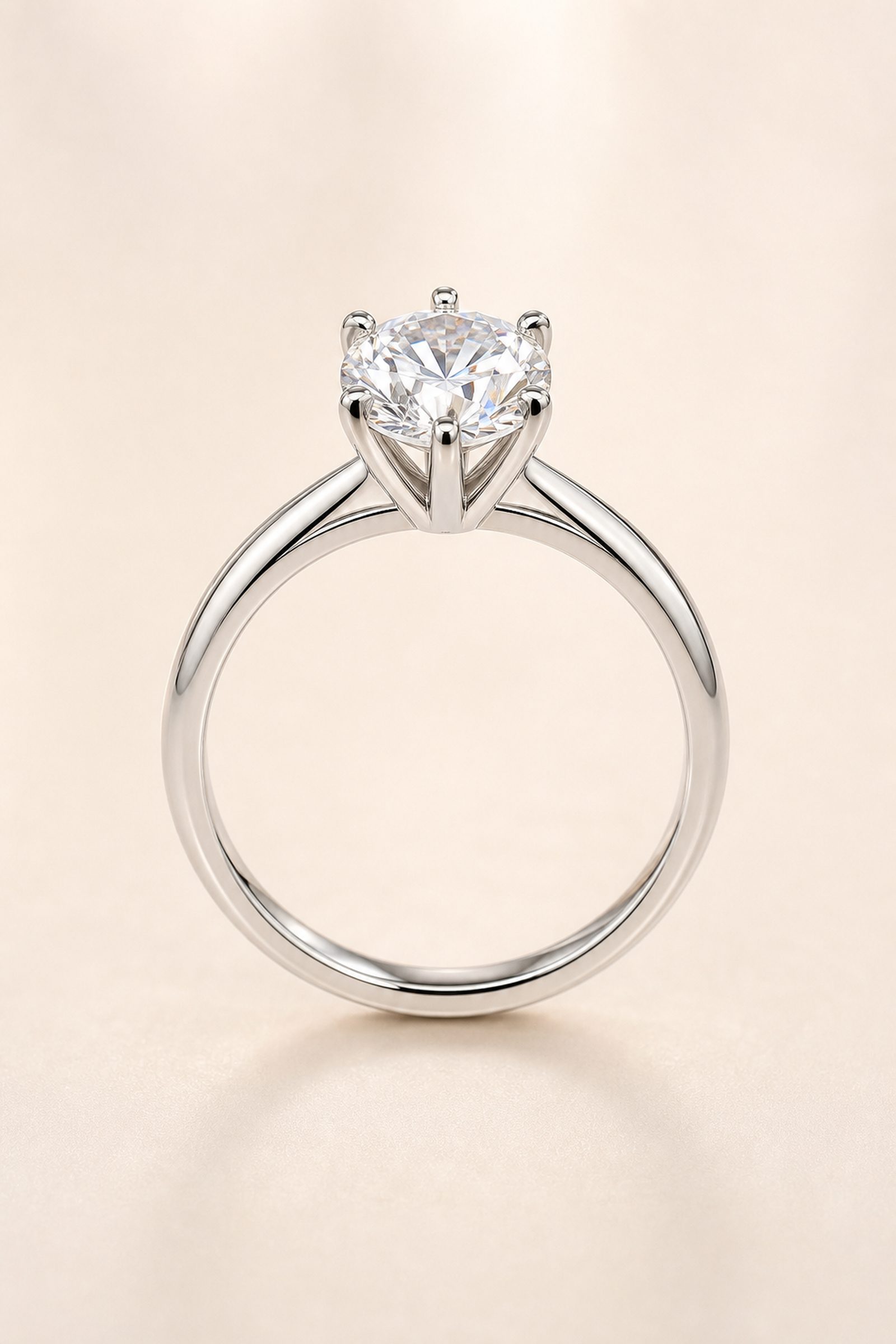
We sketched a three-stone. The original 0.72 ct round in the centre, two matched sides cut at Procut DCW or sourced to spec, the entire thing reset in platinum, lifted slightly on the finger, with a hidden detail on the gallery he asked for at the very end of the session and which is between him and her.
Sourcing the side stones
Matching to a 2001 chain-store G SI1 of unknown cut origin is not the same exercise as matching to a modern GIA report. The face-up colour read warmer than a modern G in our daylight tray, partly because of the cut and partly because of twenty-five years of skin oils settling into the girdle which we did not clean off. The right match was a pair of H VS2 GIA-Excellent rounds at 0.55 ct each.
Procut had two stones that fit, both polished in February from a single piece of rough we bought at a DBCM viewing in Johannesburg. They had been waiting in the safe for the right commission. Set on the daylight tray either side of the centre, they read as the same diamond aged a year, not as a different stone trying to keep up. He picked them in about thirty seconds.
The setting
Platinum, three-stone, low gallery, sides set in shared V prongs that picked up the centre claws so the metal read as one continuous piece rather than three small fences. Bench finish was a satin top with polished prong tips, his request. The hidden detail on the gallery: their wedding date in Roman numerals, engraved by the bench engraver, only visible if you turn the ring inside out.
The timeline
| Week | Stage |
|---|---|
| Week 1 | First visit. Original ring photographed, stone weighed and graded by eye on the bench. |
| Week 2 | Side-stone shortlist on the daylight tray. He picked. Ring deposit signed. |
| Week 3-4 | CAD render approved by him in person; small adjustment to the height of the centre to clear the wedding band she already wore. |
| Week 5-7 | Manufacturing on the bench. Casting, setting, polish, engraving. |
| Week 8 | He collected the ring on a Friday. Anniversary was the Saturday. |
The morning of the anniversary
We do not know what he said when he gave it to her. He sent us a photograph the following Monday, again of her hand on the steering wheel, this time of a car they were driving from Johannesburg to a lodge in the Eastern Cape.
The original 0.72 ct stone, in the middle of the new ring, catching the same morning light as it had on the way to Sutherland in 2001. We keep the photograph in a folder on the bench. It is the closest thing we have to a brand manifesto.
The arithmetic
The total invoice came in at approximately what a chain retailer would charge for a single 1.50 ct GIA-Excellent round in a comparable platinum setting, before bringing the original stone into the equation at all. He paid less for the upgrade-as-three-stone than he would have paid for an equivalent-carat solitaire upgrade at the same chain where he bought the ring in 2001.
The reason that works is the structure of the chain: the side stones came off the bench that polished them. The platinum was bought at source. The bench labour is in-house. Nothing was bought from a wholesaler in between.
What this story is, and is not
It is not a sales pitch for upgrading away from your original stone. The opposite. The Upgrade Promise exists for the buyer who genuinely does want a bigger or better centre, and we honour the original wholesale invoice when they trade in. But there is another path, the one this couple took: keep the stone, build the ring around it, let twenty-five years stay on the finger. The bench is set up for both.
If this is the kind of work you have in mind
Anniversary commissions where the original stone stays in the centre take six to eight weeks from first viewing to hand-over. We can quote on the sketch from the original ring. No certificate required on the centre stone; we will grade it on the bench at the first session and tell you what you have.
Brief us on an anniversary commission Read the Upgrade Promise →