
Heirloom · Custom commission · 7 min read
A grandmother’s solitaire becomes a three-stone, twenty-five years on.
She arrived at the viewing room with her grandmother’s ring in a small velvet pouch and a question she could not quite finish. Could you make this into something my partner could wear, without losing what it was?
The brief
The original ring was a 1962 engagement piece bought in Johannesburg: a single 1.04 ct round brilliant in a 9 kt white-gold six-claw mount, the kind of solitaire that used to be made when South African diamond houses were all family operations. The stone had been worn for fifty years on her grandmother’s hand, then sat in a drawer for ten more after she died.
The brief was simple to say and harder to do: keep the centre stone; design something that her own partner would want to wear daily; and use the original ring as raw material for the new one, not as a museum piece to be photographed and put back in the drawer.
Reading the centre stone
The 1962 stone was uncertified. We took it out of the mount and sent it to GIA South Africa, in the same building as our viewing room, on the same floor, for a fresh report.
The result, as expected for an older SA stone, was a strong cut grade by the standards of its era and not by the standards of GIA Excellent today: a 1.04 ct round brilliant, J colour, VS2 clarity, with a pavilion angle slightly steeper than modern targets and a thicker girdle than current fashion accepts.
Re-cutting the stone was an option we discussed at length. Re-cut to a modern GIA-Excellent profile it would have come out to approximately 0.91 ct, a 12% weight loss but a meaningfully different light return. The family declined. The ring was emotional, not aspirational.
The stone they remembered on their grandmother’s finger was the stone with that exact spread, that exact shade of warm white, that exact small chip on the table edge. Re-cutting would have erased it.
We went the other direction. We kept the centre stone exactly as it was, including the chip on the table, which a careful jeweller would polish out and a careful family would not.
Sourcing the side stones
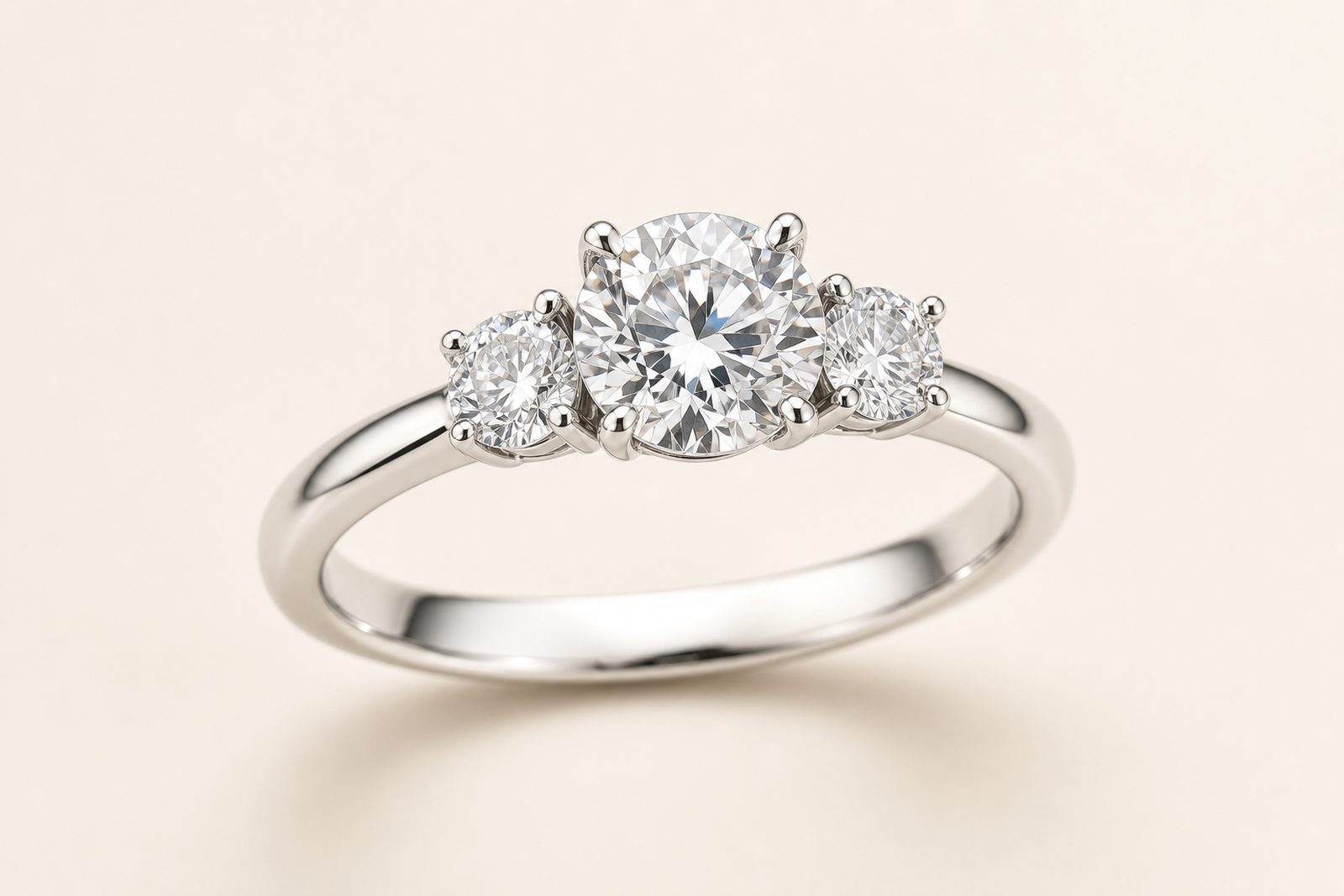
The brief settled on a three-stone platinum design: the 1962 round at the centre, flanked by two matched round-brilliant sides. The challenge was the match. The centre stone’s J colour and slightly warm body meant that two D-F colourless sides would glow next to it; two K-L sides would weigh the ring down.
The right match was H-I, near-colourless, of a slightly warmer cast, with a face-up size that complemented rather than competed with the centre.
We worked the bench. Procut DCW had two stones from the most recent De Beers DBCM viewing that were close: 0.62 ct H VS1 and 0.62 ct I VS2, both GIA-Excellent rounds, both polished in our cutting works in March. Side by side next to the centre on the daylight tray, they read as a single trio rather than three different stones. The family looked at them once and chose without hesitation.
The setting
The setting brief came from her partner: nothing fussy, nothing easily caught on a horse’s mane (he was a farrier; she was a vet), nothing that telegraphed luxury. The bench made a flat-topped platinum three-stone with sides set in low V-prongs and a centre in a four-claw mount slightly higher than the sides, classic proportions, almost mid-century in feel.
The 9 kt loose white gold from the original mount was returned to her in a small envelope; it was emotionally important to her not to discard her grandmother’s metal, even though it could not be reused in a platinum setting.
The timeline
| Week | Stage |
|---|---|
| Week 1 | Initial viewing, brief agreed, original ring photographed and de-mounted under her witness. |
| Week 2-3 | GIA grading of the centre stone; matched-side shortlist assembled and presented in person. |
| Week 4 | Side stones selected; CAD render of the three-stone design approved. |
| Week 5-7 | Bench manufacturing of the platinum mount; setting and final polish. |
| Week 8 | Hand-over at the Bedfordview viewing room; signed certs across. |
The hand-over
She came to collect with her partner. The original 9 kt returned-metal envelope; the two new GIA reports for the side stones, signed across with the inscriptions matched under the loupe; her grandmother’s 1962 stone, set between them. She wore it out of the room. He posted us a photograph of her hand on a horse’s neck two weeks later. We keep it on the bench as a reminder of what the chain is for.
The arithmetic
The total invoice for this commission, two GIA reports, two matched 0.62 ct GIA-Excellent rounds at bench prices, the platinum mount, the bench labour, and the hand-over, came in at a meaningful fraction of what a comparable three-stone in the same metal and with comparable sides would have cost at a chain retailer. The exact number is between us and the family.
The reason it works at this price is the structure of the chain: the side stones came off the bench that polished them. There was no wholesaler. There was no importer. There was no retail margin.
If this is the kind of work you have in mind
Heirloom commissions take 6-10 weeks from first viewing to hand-over. We can work entirely from the existing piece (no original certificate required), and we will tell you up front what the centre stone is likely to grade at, what your matching options are, and what the timeline looks like.
Brief us on an heirloom commission See the custom-engagement process →